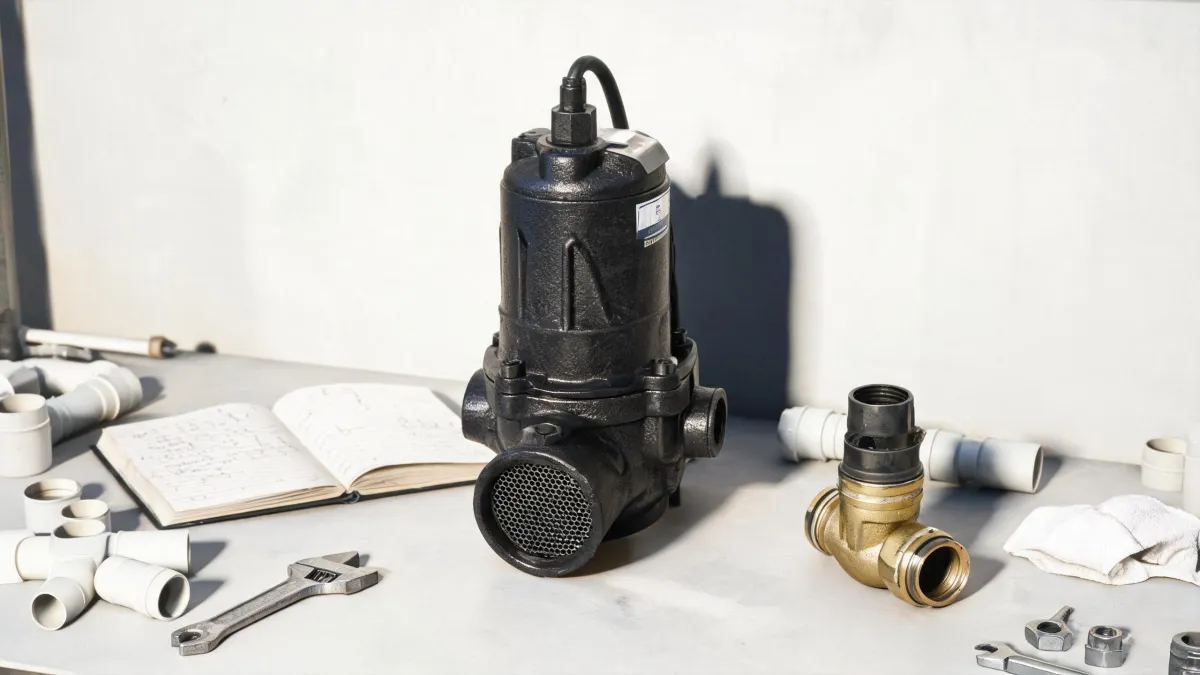
There's a question that shows up in my inbox every spring: 'Everbilt vs Zoeller sump pump, which one is actually better?'
Most people expect a simple brand answer. I can't give one, because that's not the right question. I'm a quality compliance manager at a pump supply company. I review product specs before they reach the shelf—roughly 200 unique items a year—and I've rejected plenty of first deliveries because the numbers didn't match. In my experience, the brand matters less than the application. But some brands make it a lot easier to make the right choice.
The Surface Problem: The Pump Is Running, So Why Is the Basement Still Wet?
A contractor calls and says, 'I swapped in a sump pump last week. It's cycling every two or three minutes, and the pit still won't stay down.' The first question I ask: 'Did you install a check valve?' More often than you'd think, the answer is silence.
From the outside, the system looks fine. The pump makes noise, water moves through the hose, and the power is on. The reality is that without a check valve, the water in the vertical discharge pipe flows backward into the pit every time the pump stops. That creates a loop: pump runs, water goes up, pump stops, water falls back, pump starts again. A good pump can survive that for a while. A marginal pump won't.
The Hidden Difference: It's Not Just the Nameplate
When someone searches 'Everbilt vs Zoeller sump pump,' they see two boxes that look similar. Both have a float, an outlet, and a price. The hidden difference is in the casing, the switch, and the service history. Everbilt is a big-box house brand, and some of those pumps are fine for the money. Zoeller is a manufacturer that has been doing pumps for a long time, and most of its residential sump pumps are cast iron with a beefier switch design.
But here's where I get picky: I don't care about the logo. I care about whether the pump was designed for the water it's handling. A sump pump is made for clear-ish groundwater. If you're tying into sewage, you need a grinder pump.
That's why the phrase 'Zoeller 1 hp grinder pump' keeps coming up in search. A 1 hp grinder pump is not a heavy-duty sump pump. It's a different animal. It grinds solids and pumps everything through a small-diameter discharge line. If you install a regular pump on a sewage line, the brand won't save you. The impeller will eventually clog, the motor will struggle, and the failure will be messy.
People assume any pump will handle any water. What they don't see is the internal impeller clearance and the solids-handling rating on the data sheet. That's the kind of detail that gets ignored until something backs up.
I ran a blind comparison of two similarly-priced pumps a few years ago. The results were not what I expected. The lower-priced unit moved more water in the first five minutes. The higher-priced unit still moved more water after 18 hours of continuous cycling. That's the difference that doesn't show up in a screenshot.
The Cost of Getting It Wrong
I'll give you a real number. In 2024, we had a failed check valve on a sewage ejector installation. The pipe wasn't supported properly, the valve stuck open, and sewage backed up into a finished basement. The redo cost more than $20,000. Maybe $22,000. I'd have to check the job ledger. The pump itself had nothing to do with it.
That's the pattern I see over and over: the pump gets blamed, but the system around it was the problem. An undersized discharge pipe, no check valve, a float switch catching on the pit wall, or an extension cord dragging down the voltage—any of those can kill a pump. And when the pump finally fails, the replacement is always more expensive than the part that caused the issue.
The Practical Fix: Kit It Out the Boring Way
Here's the thing: the best pump installation is boring. The pump is sized correctly, the discharge pipe is clean, and the check valve is in place. No alarms, no blinking lights, no flood.
Start with the right pump. If you're dealing with sewage or effluent, spec a grinder pump—like the Zoeller 1 hp grinder pump—or a unit that clearly lists solids handling. If it's clear water, a cast-iron sump pump with a quality float switch is a solid choice.
If you're comparing Everbilt vs Zoeller sump pump, don't make the decision on price alone. Look at the impeller housing, the switch type, and the warranty process. I've seen the Everbilt handle a basic pit for years without issue. I've also seen it get returned after one wet season because the float arm hung up. Neither outcome tells you what will happen in your customer's pit.
Second, install a check valve. Every sump pump discharge line should have one. A check valve for a sump pump is a small part with a big job: it stops the water from falling back. Spend the money, install it right, and adjust it so it doesn't slam. Your pump will cycle less, and you'll stop getting those 2 a.m. calls.
Third, carry the tools that make a clean install possible. A 3200 psi pressure washer is useful for clearing a pit of silt and debris before you drop in a new pump. It will not fix a float that's pointing the wrong way, but it will keep the pit floor from becoming talcum powder over five years.
And if you've ever wondered what a manual impact driver is, put one in your truck. It's a hand-held tool with a spring-loaded mechanism: you hit the back end with a hammer, and it turns the bit sharply enough to break loose a seized screw or a stuck cleanout plug. I used to think it was a gimmick, until I had to remove a corroded clamp from a check valve in a cramped pit. No batteries, no sparks, no frustration. Well, less frustration.
One more thing from a quality-control perspective: keep a log. I know it sounds like paperwork, but in 2024, after I started tracking every field failure in a simple spreadsheet, I found a pattern. Most callbacks came from installations that skipped the check valve or used an undersized discharge line. The spreadsheet didn't fix the problems. It just told me where to focus. Data doesn't replace judgment; it points the flashlight.
So, Zoeller or Everbilt?
Here's my honest answer: I'd choose Zoeller for a main pump in a basement I care about, mostly because of the cast-iron construction and the reliability history. I'd consider Everbilt for a backup-only system where the stakes are lower. But neither decision matters if you skip the check valve or spec the wrong pump type.
No brand can guarantee a flood-free basement. Anyone who says otherwise is selling something. The goal is to reduce the odds: right pump, right valve, clean pit, and the right tools in your truck.

Leave a Reply