-
Is Zoeller worth the premium over cheaper sump pumps?
-
Are the Zoeller Flow-Mate submersible sump pump reviews accurate?
-
What should I know before installing a Zoeller ejector pump?
-
What does the sump pump warranty actually cover?
-
When do I need 1" NPT cast iron circulator pump flanges?
-
What size hole saw do I need for a MrCool mini split?
I've been managing purchasing for a 14-person plumbing and HVAC contracting company since 2019. That means I track about $180,000 in annual spend across pumps, parts, and tools, and I've documented every order in our cost tracking system. Over the past seven years, I've bought and tracked more than 400 Zoeller pumps—sump, sewage, effluent, and backup—plus the flanges, check valves, and accessories that keep them running. I've also negotiated pricing with over a dozen suppliers along the way.
This FAQ answers the questions our installers and clients ask most. What I know firsthand, I'll tell you directly. What you should verify yourself, I'll flag it so you don't get burned by outdated info.
- Is Zoeller worth the premium over cheaper sump pumps?
- Are the Zoeller Flow-Mate submersible sump pump reviews accurate?
- What should I know before installing a Zoeller ejector pump?
- What does the sump pump warranty actually cover?
- When do I need 1" NPT cast iron circulator pump flanges?
- What size hole saw do I need for a MrCool mini split?
Is Zoeller worth the premium over cheaper sump pumps?
For most residential and light commercial jobs, yes. But that's invoice data talking, not brand loyalty.
In early 2022, I ordered eight budget sump pumps at about $89 each to help a landlord client cut costs. Everything I'd read online said budget pumps were “good enough” for light duty. I tracked every unit in our cost system for 18 months. Four failed and went back under warranty—labor on us. One died at month 14, outside the warranty window, and the tenant's basement flooded. By the time the redo was settled, each of those “cheap” installs came out way more expensive than a Zoeller M53 purchased up front.
The difference is the cast iron wet end. When a plastic-bodied pump seizes, it usually takes the float switch and check valve down with it. You replace the whole unit. On a Zoeller, parts are serviceable individually—a $40 repair instead of a $300 replacement. That is real savings, not marketing.
There are still jobs where I'll spec a budget pump. A temporary fountain or an easy-access utility pit? Fine. A basin tucked under a finished basement? I'm not saving $60 to bet against a $5,000 redo.
Are the Zoeller Flow-Mate submersible sump pump reviews accurate?
The Flow-Mate M53 is one of the most-reviewed submersible pumps we sell, and I've read through a few hundred reviews over the years. The common complaints—“noisy on startup” and “float switch sticks”—are real, but they're usually not the pump's fault.
Noise almost always comes from the discharge pipe hammering against a floor joist. A $3 rubber coupling and a support strap fixes it. The float problem usually traces to a basin that's too small for the vertical float to travel. Installers jam it in, the float binds, and the pump doesn't turn on. That's an installation error, not a manufacturing defect.
What most reviews miss is that the Flow-Mate's float switch is adjustable. Our technicians set the on/off levels to match the basin depth without pulling the pump out. Many comparable pumps leave you stuck with the factory setting. In 2023, those two checks—pipe support and float clearance—accounted for most of our sump pump callbacks, and fixing them is cheap.
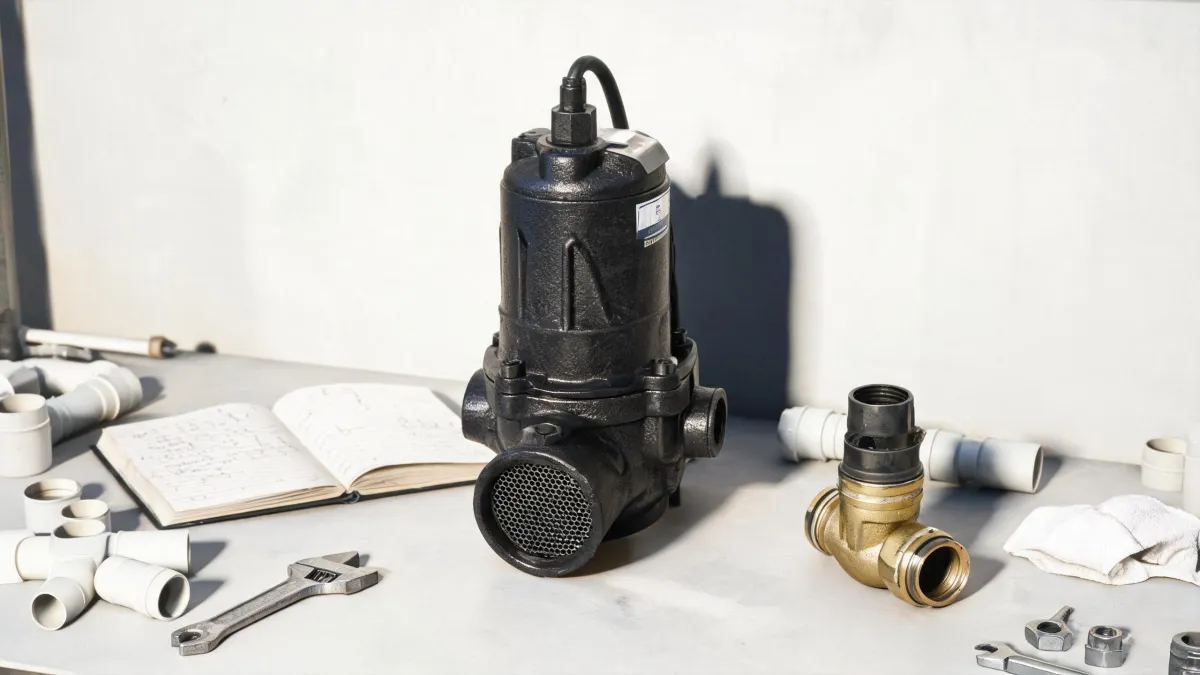
One practical warning: the M53 is the 1/3 HP model; the M57 is 1/2 HP. They look nearly identical in product photos. I've caught customers ordering the wrong one more than once. Check the model number, not the picture.
What should I know before installing a Zoeller ejector pump?
Ejector pumps get mis-specified because people treat them like sump pumps. The Zoeller 104 series, for example, handles sewage duty and can pass 2-inch solids. That changes the installation requirements.
First, the basin. For a typical residential ejector application, use at least a 24-inch diameter basin that's 30 inches deep. Anything smaller, and the pump short-cycles, which wears out the motor early. We saw an 18-month failure on a job where an old 18-inch sump basin got reused for an ejector. The basin isn't where you save money.
Second, venting. The basin has to be vented per your local code. Our counties changed the requirement in 2021, and we got flagged on an inspection because I didn't catch the update. Verify with your local building department before you set the pit—codes vary significantly.
Third, piping design. The discharge diameter needs to match the pump curve, and that's not a guessing game. I'm the buyer, not the engineer. Our senior tech specs the piping, and I order to that spec. Knowing where your own expertise ends is part of keeping job costs under control.
What does the sump pump warranty actually cover?
Zoeller's residential sump pumps carry a limited warranty—commonly two years from the installation date—covering defects in materials and workmanship. Terms vary by model, so verify the current wording at zoeller.com.
Here's what catches people: labor is not covered. That's standard across the industry, but it still surprises homeowners. When a pump fails in warranty, the homeowner pays us $150-250 to remove and replace it. The part may be free; the labor is not.
Installation conditions matter too. Zoeller asks for installation details before approving a claim. If the pump ran dry, the float jammed on debris, or the wiring wasn't to code, the claim gets denied. “Improper installation” appears in warranty terms for a reason. We keep every receipt and installation record scanned for that reason.
Compared to other brands in this class, the coverage terms are similar. The difference shows in claim frequency. It took me about four years of warranty paperwork to understand that. Over the last 12 months, we sold roughly 100 Zoeller units and filed two claims. Across seven years of orders, that consistency is what justifies the price.
When do I need 1" NPT cast iron circulator pump flanges?
This is a parts-order blind spot. Many cast iron circulator pumps ship as just the pump body—flanges are a separate purchase. If you're putting the pump into a hydronic system with 1-inch threaded piping, you need a pair of 1" NPT cast iron flanges before installation can start.
I recommend cast iron over stamped steel for closed loops. Stamped steel flanges corrode faster and leak sooner. We pay about $15-30 per pair depending on brand (based on supplier quotes, February 2026—verify current pricing), and we keep a small box stocked so a job never stalls over an $18 part. We also roll those into quarterly supply orders instead of paying retail for an emergency one.
Compatibility caveat: flange bolt patterns are not universal. Check the pump's installation manual or ask the manufacturer before ordering. I won't give you a blanket fitment answer, because a wrong flange turns a five-minute fix into a supply-house trip.
What size hole saw do I need for a MrCool mini split?
For most MrCool DIY and traditional mini split systems, you'll need a 3.5-inch hole saw for the line set and condensate drain. Some larger models with heavier line set insulation spec a 4-inch hole. The install manual for your specific unit is the final authority.
We've had crews show up with a 2.5-inch bit because that's what worked on a standard mini split line set, only to find the MrCool connection is bigger. That's a wasted trip and a $90 truck roll. A 3.5-inch bi-metal hole saw runs about $15-40 at typical supply houses (early 2026 pricing—verify current).
Also plan for the wall itself. A 3.5-inch hole through a stud bay is manageable with a standard drill. Through brick or concrete, you're looking at a rented core drill and a 4-inch core bit, which runs $80-120 at rental yards (pricing from February 2026—verify current). Budget for it before the job, not after. And if you're doing multiple units, buy the hole saw once and keep it on the truck—it pays for itself after two jobs.

Leave a Reply