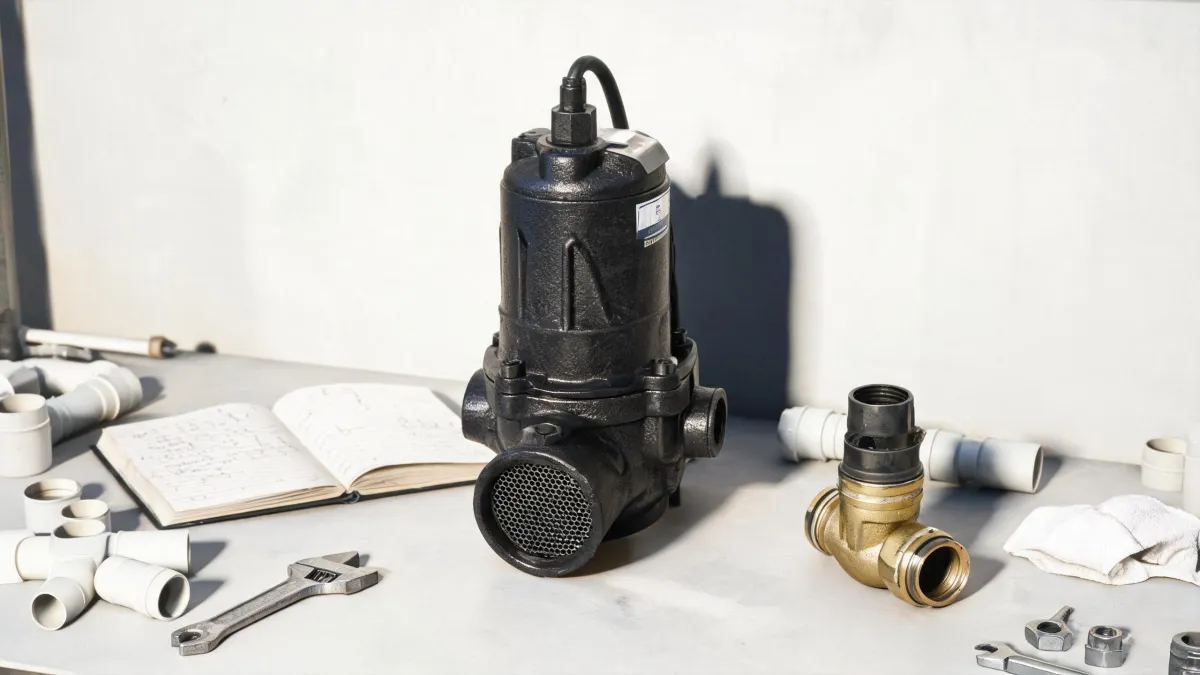
I'm the quality and brand compliance manager at a plumbing and HVAC supply house. I review roughly 400 pump packages and warranty claims a year before they reach a customer. Last year I rejected 22% of first-submission submittals—not because contractors picked bad products, but because they were solving a different problem than the one in front of them.
Here's the thing nobody tells you when you're starting out: there is no "best sump pump." There's only the right pump for your specific scenario. I watched a crew burn nine days and $900 because they treated a planned replacement like an emergency. I've also watched a homeowner flood a finished basement because the contractor treated an emergency like a planned replacement.
Four scenarios cover roughly 90% of the calls that hit my desk. Figure out which one you're in before you open a catalog.
Quick Scenario Checklist
- Scenario A: Standing water. Pump failed. Finished basement.
- Scenario B: New construction or planned upgrade. No water on the floor.
- Scenario C: Rural / deep-well water supply — a submersible well pump, not a sump.
- Scenario D: The system works, but you're chasing repeat callbacks on the small stuff.
Scenario A: Emergency Replacement in a Finished Basement
This is where I made the classic rookie mistake. In my first year of writing submittals, I assumed "standard" meant the same thing to every vendor. Cost me a $600 redo on a job that didn't need one. Same trap applies here: the fastest path is not "order the exact model you just pulled out."
The fastest path is: call the manufacturer's technical line before you guess. Zoeller sump pump customer service is one of the few I'll actually put a contractor on hold for. They'll confirm the discharge diameter, the switch type (vertical float vs. tether vs. diaphragm), and the amp draw against your circuit in a single conversation. Fifteen minutes that saves you a return freight charge and a second trip out.
Three things to check while you're on that call:
- Basin diameter and depth. A 1/3 HP pump in an 18-inch basin will short-cycle and die inside eighteen months. If your basin is undersized, no pump brand on earth fixes that.
- Head height, not just horsepower. Measure from the pump discharge to the highest point of the line. Add 1 foot of head for every 10 feet of horizontal run. Contractors skip this constantly.
- Switch clearance. If the lid has a narrow cord pass-through, a vertical float switch will hang up. Tether switches need swing room. This is where a "same model" replacement goes wrong most often.
And the housing matters more here than anywhere else. Zoeller's cast iron bodies dissipate heat and resist corrosion in a way thermoplastic doesn't. Cheaper thermoplastic is fine for a laundry tray or a utility sink. In a finished basement where a failure means new drywall and new carpet? Not always the right call—but in this scenario, yes.
Scenario B: New Construction or Planned Upgrade
Entirely different game. You have time, you have drawings, and you can specify once and forget it. This is where efficiency actually pays for itself—not the pump's efficiency, the system's efficiency.
Three specs I insist on in every planned submittal:
1. Battery backup with a real alarm. Not the beeping-only kind. One that texts. I had a client last year swap a beeper-only backup for a monitored unit; callbacks dropped from eleven a season to two. That's not marketing—that's a service log.
2. A high-water alarm separate from the pump switch. Redundant, yes. But the alarm tells you before the flood, and the switch tells you during.
3. A discharge check valve rated for the pump's shutoff head. The cheap spring-loaded brass valves off a big-box shelf look fine on paper. Then a 1/2 HP pump with a 25-foot shutoff head pops the spring. I've seen it happen twice in one month.
The genuine binary struggle here is Zoeller vs. one of the lower-cost imports. On paper, the import saves about 25% per unit. In practice, I've replaced more of them at year three than I'd like to admit. That's the decision, and it depends on the job. Rental property you'll sell in two years? Take the savings. Your name on the warranty card? Take the cast iron.
Scenario C: Rural / Deep-Well Water Supply
Different product category entirely, and I see it confused with sump work every week. A Zoeller submersible well pump is not a sump pump with a longer cord. It's a 4-inch-casing pump that lives 80 to 400 feet underground and pushes water up, not out.
What actually matters here:
- Static water level and drawdown. Not the total depth of the well. The depth of the water.
- Pressure tank sizing. A 20-gallon tank on a 1/2 HP pump feeding a household of four will short-cycle the motor to death.
- Control box compatibility. Three-wire pumps need a control box; two-wire pumps don't. Swapping one for the other is a rewiring job, full stop.
Verify the pump's listing against UL 778, the standard for motor-operated water pumps. As of 2025, that listing is still the fastest way to spot a counterfeit "Zoeller-compatible" unit on a marketplace listing.
Scenario D: Chasing Callbacks on the Small Stuff
This is the scenario most contractors ignore, and it's the one that costs the most over a year. The pump is fine. The system around the pump is annoying the customer.
The valve question
I get asked how does a globe valve work at least once a month, usually right after someone installed one where it doesn't belong. Short version: a globe valve has a disc that moves perpendicular to the seat (the flow path makes an S-shape through the body). That geometry gives you excellent throttling control—better than a gate or ball valve—but it also means higher pressure drop when fully open. So:
- Use a globe valve where you need to regulate flow: trimming a discharge line, balancing a zone.
- Do not use a globe valve as a shutoff on a sump discharge. Every partial-open position wears the seat. Use a full-port ball valve for isolation.
Get that backwards and you'll be back in eighteen months replacing a valve seat instead of enjoying your weekend.
The tool side
Two tools I keep on the truck for pump work. First, a set of Cobra QuickSet water pump pliers—the push-button self-locking jaw style. One-handed adjustment matters when you're upside down in a crawlspace holding a flashlight in your teeth. Second, whatever air compressor model 2475 you've got in the shop (mine is an old Campbell Hausfeld) for pressure-testing new discharge lines before the wall closes up. Fifteen PSI for ten minutes. If it holds, you're done. If it doesn't, you just saved yourself a callback.
Neither tool is glamorous. Both cut about thirty minutes off a typical replacement. Do that four times a week and it's a real number.
How to Figure Out Which Scenario You're In
Answer three questions, in order:
- Is there water on the floor right now? Yes → Scenario A. No exceptions.
- Is the water source a well, or a basin? Well → Scenario C. Basin → question 3.
- Have you been to this address more than once in the last twelve months? Yes → Scenario D. No → Scenario B.
That's it. The whole decision tree collapses to those three questions. I still kick myself for the years I didn't ask them—if I'd run this checklist from day one, I'd have dodged most of my worst submittals.
One last thing. After you commit to a scenario and place the order, there are always two days of "did I make the right call?" That's normal. I still get it. The cure is a documented spec sheet, a signed cutoff, and a phone number you actually called. Hit all three and the second-guessing stops.

Leave a Reply