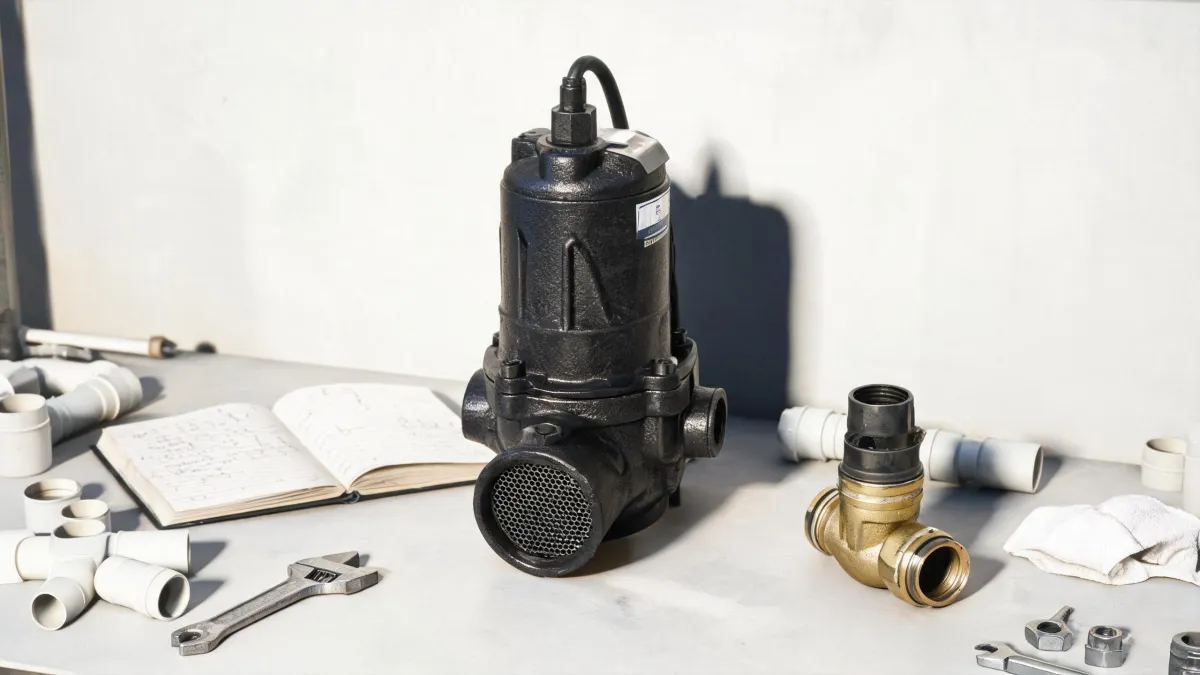
In September 2022, I got a call at 6:40 a.m. from a customer whose finished basement had about three inches of standing water in it. The sump pump was 14 months old. It had run all night — you could hear it from the stairs — and the basement still flooded.
The obvious conclusion, and mine too at first: bad pump. Fourteen months is short for a sump pump. We pulled it and I took it back to the shop expecting a seized impeller or a burned-out motor.
It ran perfectly on the bench. Pulled water clean, no heat, no noise.
The check valve had a piece of gravel wedged in the flapper.
Total damage: about $8,400. Drywall, baseboard, and flooring in two rooms, a dehumidifier rental, and three days of a crew that should have been on another job. The part that actually failed retails for under $25.
For context — I've been ordering pumps and tools for a mid-size plumbing and waterproofing outfit since 2007. Over that stretch I've logged roughly $19,000 in purchasing mistakes. That flood is the one I keep coming back to, because I didn't buy anything wrong. I just diagnosed the wrong thing.
The pump is one part of six
Nobody tells you this when you buy a sump pump, and it's the reason I've replaced a lot of pumps that were never broken. A working sump system is at least six components:
- The basin and its inlet
- The switch or float
- The pump itself
- The check valve
- The discharge line and where it terminates
- The power source, including the backup
Every one of those can fail in a way that looks exactly like a dead pump from the top of the stairs. Water rises, pump runs, water doesn't move.
The check valve is the first thing I check now. Stuck open, water in the discharge line drains back into the basin the moment the pump shuts off. The pump kicks on again 90 seconds later. And again. And again, all night, until the motor overheats and dies — at which point everyone agrees the pump burned out. It did. It was also murdered. Stuck closed is a different flavor of the same problem: the pump runs against a dead head, nothing moves, and you get heat instead of flow.
The discharge line is where cheap installs hide. A 1-1/2 inch line reduced down to a garden hose adapter adds head pressure the pump wasn't sized for. A line that dumps two feet from the foundation just puts the water back where it started. In cold climates, a discharge that holds water through the winter freezes solid, and the pump runs against an ice plug until it quits.
The switch sets your on and off points. Change the switch type and you change how often the pump cycles — sometimes from a few times an hour to a few times a minute during a storm. That's a pump killer, and it's invisible on a spec sheet.
The power side gets skipped constantly. A tripped breaker nobody noticed. A receptacle on a circuit shared with a chest freezer. A backup battery that's never been load-tested. A sump pump with a battery backup and a dead battery is just a sump pump.
When I finally put the two units side by side on the bench — the 14-month-old one that “failed” and the 11-year-old one it replaced, still running in a different house — I understood why we kept replacing pumps instead of fixing causes. We'd been buying motors to solve valve problems.
The part number trap
Here's where I've personally lost the most money, and it's the reason I'm writing this down.
Pump part numbers aren't just a base model. The letters and digits after the dash are configuration codes — switch type, cord length, voltage, sometimes impeller material. They are not decoration. Two listings can share the same base model number and still be genuinely different products, and the photos will look identical because the differences sit inside the housing or under the float.
When you search for something like 6EC-CIA-SFS sump pump 506807, you're looking at exactly the kind of listing this bites hardest. The base model tells you the pump family. The suffix tells you which version of it. Order by the base model and assume the rest matches, and you're flipping a coin on the switch and the cord.
I did that in March 2023. Two replacement pumps for a job with a 14-inch cast-iron basin. The photo matched, the family matched, the price looked right. What I didn't verify was the suffix — switch style and cord length. The units that showed up had different on/off levels and cords five feet shorter than the originals.
We re-piped the discharge, moved a receptacle, and paid an electrician for half a day. Call it $1,100 between the two pumps. The pumps were fine. We bought the wrong ones.
I assumed the same model number meant the same pump. I didn't verify. The number was the same and the product wasn't.
Zoeller's published catalog literature breaks down what those configuration codes mean for each number. Pull the sheet for your exact model before you click buy — not after the pallet shows up on a Friday afternoon.
Same mistake, different tools
Once I saw the pattern, I started seeing it everywhere. The failure is almost never the machine. It's the system around the machine.
Portable washer not draining
Nine times out of ten, the washer is fine. The drain path isn't. A kinked discharge hose. A hose outlet sitting higher than the machine can pump against. A drain pump filter packed with lint. A sink drain that was already slow. People replace the washer, the new one doesn't drain either, and the hose is still kinked.
Can you cut aluminum with an angle grinder?
Yes. But — and this is the whole point — the grinder isn't the question. The wheel is.
A standard abrasive wheel made for steel loads up on aluminum almost immediately. The soft metal clogs the abrasive's pores, the wheel glazes, cutting speed drops, and you start pushing harder to compensate. That's when kickback happens. You want a wheel rated for non-ferrous metal, and you want to check the speed rating: per ANSI B7.1, the wheel's maximum rated RPM has to meet or exceed the grinder's no-load RPM. A wheel rated at 6,500 RPM on an 11,000 RPM grinder is a problem no matter what's under the guard.
The grinder was fine in every one of those cases. Same as the pump.
What it actually costs
The $20 check valve cost $8,400. The wrong-suffix pumps cost $1,100. Neither number includes the callbacks, the lost crew days, or the customer who now gets their next quote from somebody else.
The real cost, though, is timing. Water damage doesn't schedule itself around your week. When the forecast calls for four inches of rain and your basin is dry at midnight, you aren't shopping for the best price on a pump. You're shopping for the certainty that the correct part is on a shelf within driving distance. Those are different purchases.
In March 2024 we paid a $190 premium for a same-day will-call pickup on a backup pump instead of saving $60 through a marketplace seller who estimated two to three days. The rain came through on day two. I've stopped pretending those two purchases are comparable. When the deadline is weather, you're buying certainty, and certainty has a price. It's usually cheaper than the alternative.
It also helps not to be shopping during the emergency in the first place. If you search zoeller pump distributors near me today and save the number, it's not because you need a pump today. It's because you'll need one eventually, and you'd rather not be comparison-shopping in a wet basement at 6 a.m. Same reason I keep a spare check valve and a spare float on the truck.
What I do now
The checklist is short and it costs nothing:
- Verify the full part number — base model plus suffix — against the old unit, not against a photo.
- Confirm the check valve and the discharge line before assuming the pump died.
- Load-test the backup battery. A Zoeller sump pump with battery backup only helps if the battery actually holds a charge when the power drops.
- Buy from a distributor who stocks the exact configuration, not from a listing that matches the picture.
- Replace the cheap parts while the basin is open. The valve is $25. The cleanup is not.
Nineteen years of getting this wrong has taught me one thing worth passing along: when something stops working, look first at the parts you didn't think about. The pump, the washer, the grinder — they're usually doing their job. Something around them isn't.

Leave a Reply