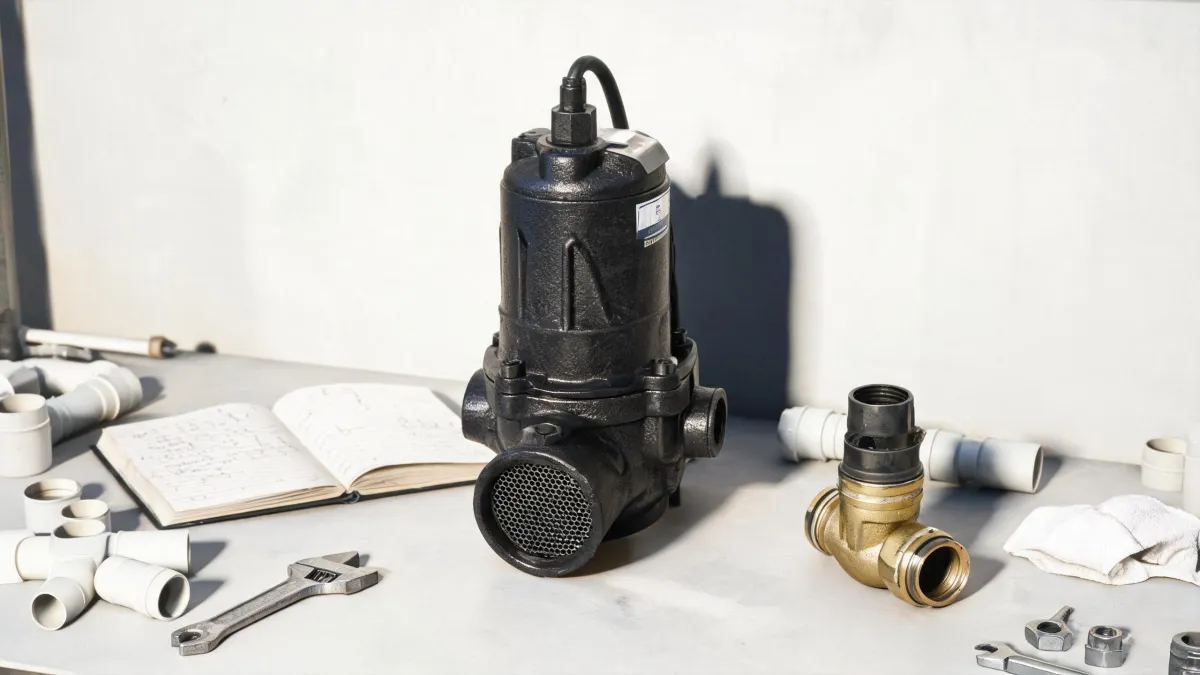
If you're about to install a Zoeller M53 (item 105-0001) and someone tells you to "just zip-tie the float cord tight so the basin looks clean," don't. That single habit caused more callbacks for me than any actual pump failure in the past 11 years. Seven out of ten "defective pump" service calls I've responded to were float-travel problems, not pump problems.
Quick background: I've handled pump orders and installs for a wholesale plumbing supply company since 2014. I've personally made—and documented—14 significant mistakes, totaling roughly $5,200 in wasted budget. The most embarrassing one involved a Zoeller pump float on a 105-0001 drain pump, a model I'd already installed dozens of times. This article is the checklist I wish I'd had before I started.
Here's the short version: give the Zoeller piggyback float room to travel. Set the tether too short, and the pump short-cycles until the overload trips. Set it too long, and the basin can overflow before the pump kicks on. Both failures look identical on a service call: the customer says "pump is broken." Nine times out of ten, the pump is fine.
The Zoeller Pump Float: Where the "Pump Failure" Actually Starts
The M53's switch is a vertical tethered float that works piggyback-style: the float plugs into the wall outlet, and the pump cord plugs into the float. As water rises, the float rises; when the water drops, the float drops and cuts power.
Why does the float fail so often? It's the only moving part in the whole system that lives in dirty water. A sump pump's motor is sealed; the switch isn't. It gets bumped, slimy, and jammed by debris. The M53's float is durable, but no float tolerates being zip-tied out of its range.
Everything I'd read when I started said to secure the float cord to the discharge pipe for a neat, professional-looking basin. In practice, that's exactly what caused my short-cycling problem. If you strap the cord close to the pipe, the float body can't fully drop when the water level falls. The pump runs, drains half the basin, but the float won't switch off until the water drops a little more—then it starts again a few seconds later. Repeat that for an hour, and the motor's thermal protector trips. The customer sees a "dead" pump.
It took three callbacks before I realized I was the one causing the failure. In September 2022, a contractor called about a "brand-new M53 that keeps shutting off." The pump tested fine on my bench. The float was zip-tied tight against the discharge pipe—by a previous installer, following the same "clean look" advice I gave in my first year. So glad I didn't just swap in a new pump; I'd have charged the customer for parts and labor and fixed absolutely nothing.
The fix cost zero in parts. The service visit cost the customer around $125, plus a dent in my credibility. After the third callback in Q2 2023, I created our pre-install checklist. Three checks on every piggyback float now:
- Float travel. The float body has to swing through its full arc without touching the basin wall, the discharge pipe, or the pump body. If it touches anything, it binds.
- Tether slack. Leave enough slack for the float to rest at its natural low position. If the cord is tensioned when the float is down, it's too tight.
- Full cycle test. Fill the basin with a bucket and watch the pump run through a complete cycle before sealing the lid. It takes two minutes and catches almost every mistake.
We've caught 47 potential float-travel errors with these checks in about 18 months. None of those turned into failed pumps, and more importantly, none turned into flooded basements.
A Few Notes on the Zoeller 105-0001 (M53) Itself
Let me be clear about the pump: the 105-0001 is the M53, a 1/3-hp submersible sump/drain pump with a cast-iron pump housing and switch case, a 1-1/2-inch NPT discharge, and a 10-foot power cord. Per Zoeller's published specifications (zoeller.com), those are the numbers, and in my experience they're accurate.
If you ask me, the M53 isn't the flashiest pump in Zoeller's lineup. It's the workhorse. I'd put it in a basement basin or a crawl-space drainage pit and not worry for years. The cast-iron body is noticeably heavier than the plastic pumps you'll see on a shelf in the plumbing aisle, and that weight is the point: it stays seated, it sheds heat, and it doesn't crack when something bumps into it.
The price makes some contractors flinch. My answer is the same every time: the lowest purchase price isn't the lowest total cost. In 2021, a customer brought in a two-year-old plastic sump pump that had failed in a rental property. He'd saved roughly $70 on the purchase. The Saturday service call to swap it, plus the new pump and the emergency supply-house trip, came to about $450. The M53 would have outlived that pump and kept going. One cheap pump failure ate six times the savings.
From a purchasing perspective, this pump is also one of the easiest SKUs I stock. Contractors order the 105-0001 by heart, they know the float setup, and they don't call back. If you're buying for a fleet of rental properties, the slightly higher unit price is the insurance; one less midnight callout pays for the difference.
That said, the M53 has limits. It's a sump/drain pump, not a sewage ejector and not a grinder pump. If you're pumping solids, get a Zoeller sewage pump. And the M53 doesn't include a battery backup system; if your area loses power during storms, you'll want to plan for that separately.
Three Jobsite Lessons I Didn't Expect to Learn
1. A metric combination wrench set belongs in every pump kit
You'd think a pump job only needs wrenches for the NPT discharge. But check valves, basin covers, and adapters from more than a few suppliers use metric hex-head bolts—usually 10mm and 13mm. I learned this after stripping a bolt on a cast-iron check-valve adapter because I grabbed a 1/2-inch wrench that was just loose enough to slip. (Note to self: 13mm and 1/2-inch are not interchangeable, no matter how confident you feel.) The bolt cost forty cents. The trip back to the truck and the rework cost an hour. A basic metric combination wrench set now lives in the same drawer as my pump tools, and I grab it on every job.
2. The tool box cooler earns its space
This sounds like a lifestyle tip, but hear me out. A simple pump swap takes an hour. A new basin in a crawl space, in July heat, with no ventilation, takes most of a day. My tool box cooler—the one that locks into the rolling toolbox stack—has saved me more times than any specialty tool I own. It keeps water cold, doubles as a seat, and gives me a clean surface for small parts (thankfully). I'd rather carry a cooler than rush a job because I'm dehydrated and making silly mistakes.
3. Know how to drill cabinet hardware holes without chipping the finish
This sounds unrelated until you're mounting a pump alarm, a control box, or a cord clip on a finished cabinet. If you've never drilled a clean hole through a cabinet face, the first attempt will teach you the expensive way. The technique is the same as drilling cabinet hardware holes for knobs and pulls: put masking tape over the drill point, use a center punch to start, drill with a brad-point bit at moderate speed, and clamp a scrap board behind the panel so the bit doesn't blow out the back veneer. I chipped a customer's vanity in 2019. The replacement door cost us $150. The technique isn't complicated; skipping it is what's expensive.
Where This Advice Doesn't Apply
Not every M53 install needs a full pre-flight. If you're doing a straight swap in an existing basin and the old float worked fine for years, take a photo of the old tether length before you cut anything, then match it. Don't redesign what's working.
Basin width changes the math too. In a narrow 14-inch basin, the float's travel range is tight, and tether length is critical. In a wide basin, you get more margin for error. And if you're using an electronic switch (like Zoeller's Smart Switch) instead of the piggyback float, the tether rules don't apply the same way—an electronic switch has no tether to misadjust.
One last confession: I'm not proud of those callbacks. But the checklist that came out of them is the most useful thing I've built in this job. There's something satisfying about watching a pump run a full cycle cleanly the first time—after all the years of fixing the same mistake, that's the payoff.

Leave a Reply