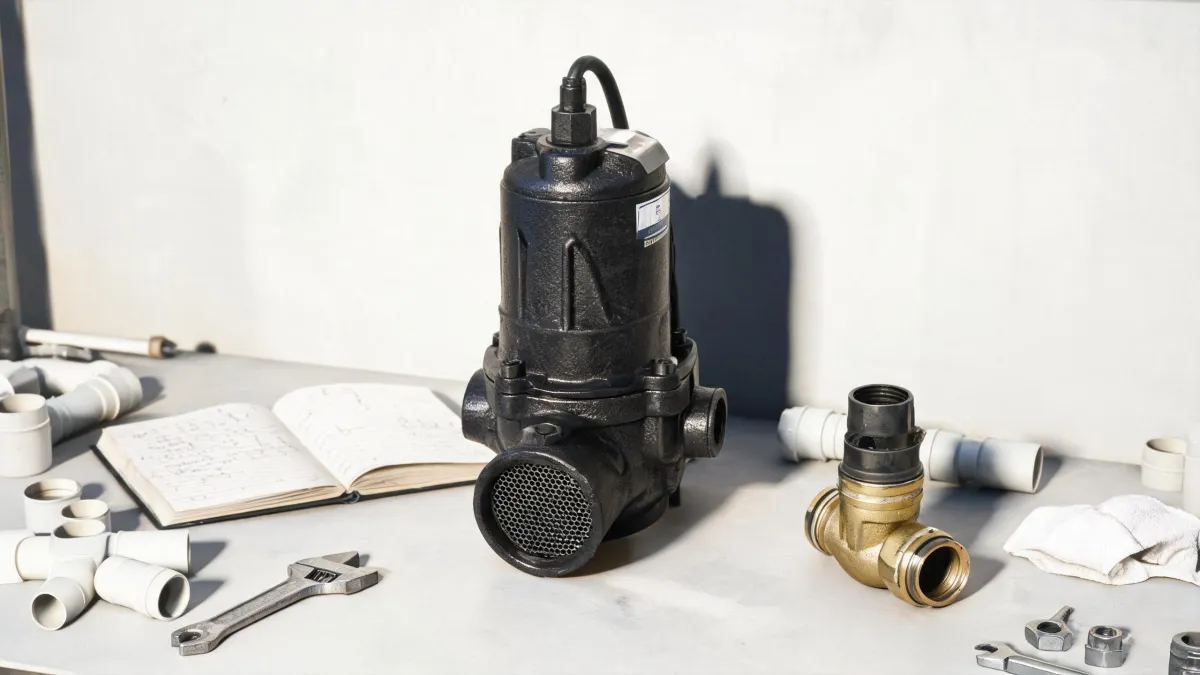
In February 2024, at 11:47 on a Tuesday night — I know the time because I looked at the phone and groaned before I answered — the after-hours line at our pump supply company lit up. A plumber I’d worked with for years was standing in a finished basement with two inches of water on the floor.
“New Zoeller pump,” he said. “Installed it two days ago. It’s running. And the basement is still flooding. How is that possible?”
That call is the reason I’m writing this. In my role as the emergency service guy, I’ve opened a lot of pits at midnight, and I’ve learned one hard lesson: the pump is rarely the first thing to fail. It’s the system around the pump that goes bad.
The Pump Was Running Fine. That Was the Problem.
The video he sent showed exactly what I needed to see. The pump kicked on, water shot out of the discharge line, the float dropped, and then you could hear it: the same water draining back down the pipe into the basin. No check valve. The discharge line went straight up about twelve feet, and when the pump shut off, gravity undid all the work.
So the pump cycled, pumped the same column of water up, shut off, lost the water, and cycled again. It ran until the motor’s thermal overload tripped. The plumber saw a hot, “dead” Zoeller pump and blamed the pump. But the pump wasn’t defective. It was being abused by an installation that didn’t include a one-way valve.
If you’ve ever wondered why a sump pump runs every few seconds even when it’s dry outside, this is usually why. The water isn’t coming in from the ground. It’s the pump’s own discharge falling back on it.
What Zoeller Pump Company Reviews Actually Tell You
I read zoeller pump company reviews the way I read reviews for anything: looking for patterns. “Died after 18 months.” “Runs constantly.” “Burned out.” A lot of those complaints end up at our shop for testing. And more often than not, the pump runs fine on the test bench. Why? Because the failure wasn’t in the pump. It was upstream or downstream of it.
I’m not a pump engineer, so I won’t pretend to give you hydraulic calculations from memory. What I can tell you after roughly 450 after-hours calls over 15 years is what actually kills pumps in the field. None of it is glamorous. It’s check valves, gate valves, and mismatched pumps.
One caveat: my experience is mostly residential and light commercial work in the Midwest. I don’t work for Zoeller, and I haven’t done municipal lift-station math. If you’re managing that kind of setup, talk to an engineer.
The Real Culprits Are Right Above the Pump
Once you stop staring at the pump, the causes of most emergency calls become predictable. Here are the three I keep finding.
Check Valves: The Reason “Quiet” Matters
A check valve is a one-way door. It lets pumped water leave the basin, then closes before that water can fall back in. If the valve is missing, stuck open, or installed wrong, the pump fights gravity every cycle.
I’m a fan of spring-loaded check valves for sump and sewage work. The Zoeller Quiet Check Valve is the one I keep on my truck. The internal spring starts closing the valve the moment the pump stops, before the water column reverses direction. That avoids the loud slam you get from a standard flapper valve — and, more importantly, it avoids water hammer.
Why does that matter beyond noise? Water hammer is a pressure shock wave. Over time, it can knock pipe joints loose, crack fittings, and turn a simple discharge line into a leak. A quiet check valve also keeps the pump from short-cycling against the standing column of water in the discharge pipe. Fewer starts per hour means less heat, less wear, and fewer 2 a.m. callbacks.
Gate Valves: The Valve That Looks Open But Isn’t
I can’t count how many service calls ended with a discharge gate valve half closed. Yes, gate valve repair parts exist — stems, packing, discs — and in a plant maintenance setting, that’s worth doing. But in a basement, a gate valve is a trap.
A few years back, a sewage ejector pump kept “burning out” every six months. Two pumps had already been replaced before I got the call. The pump was fine. The old gate valve above it had a stripped stem. The handle turned, so everyone assumed the valve was open, but the gate had barely moved in years. The pump was trying to push water through a nearly closed valve. It wasn’t a pump failure. It was a valve failure wearing out pumps.
In a basement, I’d rather see a ball valve than a gate valve. One quarter-turn, and you know from across the room whether it’s open or closed. That simple visual check saves a lot of confusion on the next service call.
Wrong Pump for the Job: The Multistage Centrifugal Pump Mix-Up
The third pattern is pump selection. People pick by horsepower, not by pump curve. Most sump pumps are single-stage centrifugal pumps. They move a high volume of water at a moderate height, and they’re great for a typical basement pit. But if you have a tall vertical lift, a long horizontal discharge run, or a system that needs more pressure, a single-stage pump may run beyond its design curve. It moves less water, runs hotter, and dies early.
That’s where a multistage centrifugal pump enters the conversation. A multistage pump stacks several impellers in series, with each stage adding pressure. It’s the right tool for higher-head applications — but it’s a different tool. I’ve seen too many people grab whatever pump is on the shelf and try to make it fit.
If that sounds like a stretch, think about the first cordless drill. Ask a room full of contractors when the first cordless drill was made, and most will guess the 1980s. It was 1961, and Black & Decker built it, according to their company history materials. The idea was right, but the battery technology wasn’t there yet, so the drill couldn’t do what people wanted. The tool wasn’t the problem. The system around it was. A pump is the same way: it can be a great pump and still fail if it’s matched with the wrong discharge setup.
The Real Price of “I’ll Deal With It Later”
I get why people replace the pump instead of the valve. Replacing the pump feels forward-moving. Cleaning a check valve means touching something gross and redoing work you thought was finished. But that’s where the real cost lives.
An after-hours service call in the pump world is rarely cheap. You’re paying for the truck, the overtime, the part, and the tech’s lost sleep. And if you’re the contractor, you’re also paying for the callback: the phone call where the customer says, “You told me it was fixed.” That reputational cost is hard to put a number on.
Then add the water damage. According to FEMA’s flood outreach materials, as little as one inch of water can cause around $25,000 in damage to a typical home. I believe it. I’ve stood in basements where the difference between a dry floor and a $25,000 claim was a $30 check valve that nobody installed.
Five minutes of verification beats five days of correction.
The 30-Minute Prevention List
Before you backfill that pit, bury that discharge line, or button up an ejector basin, do this. It takes less than half an hour, and it’s the kind of prevention that saves the next emergency call.
- Inspect the check valve. If there isn’t one, install a spring-loaded valve like the Zoeller Quiet Check Valve. If there is one, test it: pour water in the pit, let the pump run a full cycle, and confirm the water stays out of the pit after shutdown.
- Verify every isolation valve. Open and close each valve once. If you find a gate valve with a loose or stripped stem, replace it with a ball valve. Gate valve repair parts are for industrial repair jobs, not for basement service valves that need to work in an emergency.
- Size the pump to the system. If you’re near the edge of a pump’s head limit — or dealing with a long run that might require a multistage centrifugal pump — stop and read the pump curve before you buy.
- Run three full cycles before you leave. Listen for water hammer. Watch the float move freely. Make sure the pump doesn’t recycle the same water. The extra ten minutes on the front end will save you a callback later.
So yes, Zoeller makes solid cast-iron pumps. But no, that doesn’t mean they can’t be killed. They can — and often, it’s the installation that does the killing.
Next time you read a one-star Zoeller pump company review that says “died in two years,” ask the question the review never answers: What did the discharge line look like? Was there a check valve? Was the shutoff valve actually open? How many times an hour was the pump starting? The pump might have been innocent all along.
I know that from standing in cold water at midnight, knee-deep in someone else’s panic. The problem usually isn’t where everyone is looking.

Leave a Reply