It was a wet Tuesday in March 2024, around 6:40 PM, when my phone buzzed with a number I didn't recognize. That's never a good sign. The voice on the other end was one of those calm-but-freaking-out voices. A property manager I'd worked with maybe twice before had a basement filling with water. The tenant's sump pump had been making noise for two days. Then it stopped. The pit was full. Rain was moving in overnight.
I loaded the van. Sump pumps, check valves, a cordless drill, PVC glue, a hacksaw, a flashlight. And a backup pump, because I've learned that the pump you bring is never the one you need.
The Call No Contractor Wants at 6:40 PM
When I got there, the pit was so full the float switch was underwater. The old pump—a 1/3 hp submersible sump pump that had been in the house for at least a decade—was making that sad hum that means the impeller is jammed or the motor is done. I pulled the unit out and flipped it over. The bottom plate was cracked. Rust everywhere. That pump wasn't coming back.
I told the property manager, Dave, that he needed a replacement that night. He nodded and said, "You're the expert." I don't know about expert, but I've done enough of these to know that hesitation costs more than the parts.
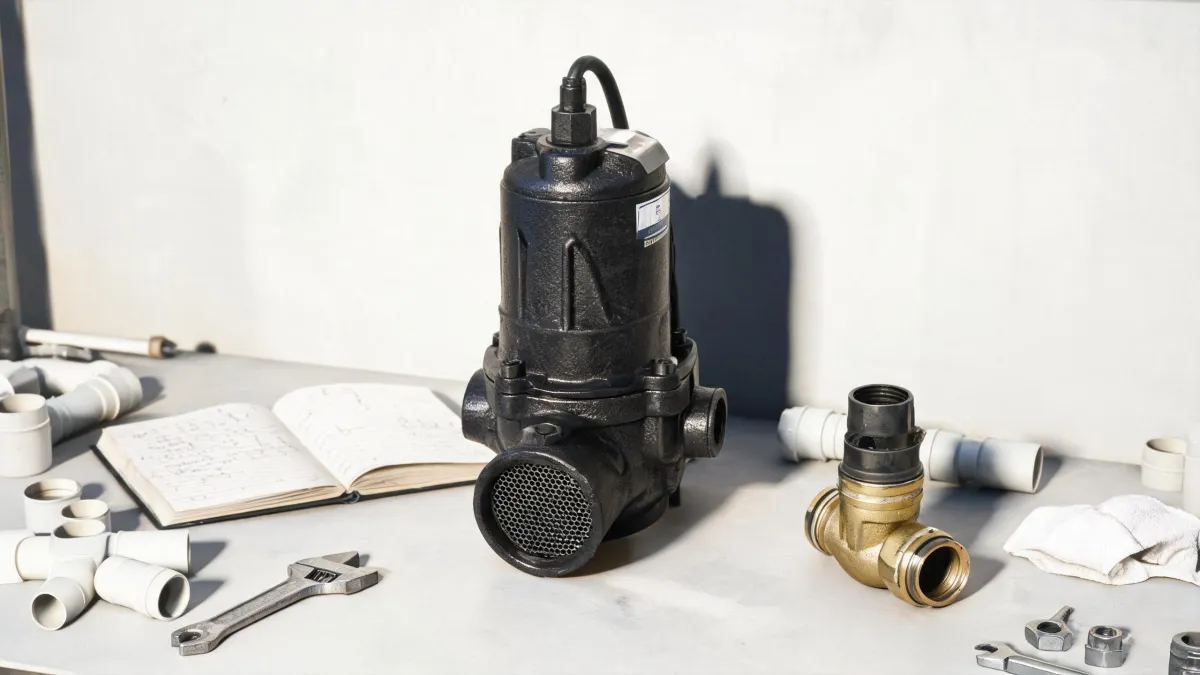
Now here's where I sound like a brand loyalist, but hear me out. I've installed a lot of sump pumps over the years. Wayne, Liberty, Superior, Zoeller. They all have their place. But when I need a pump I can install with confidence and not think about for years, I keep reaching for the Zoeller M53. That's the 1/3 hp submersible sump pump with cast-iron housing. It's not fancy. It doesn't have Wi-Fi. It just works.
Why I Keep Coming Back to the Zoeller M53
Quick context: in the world of Zoeller pumps, the M53 is the workhorse. It's a 1/3 hp submersible sump pump with a cast-iron volute—the spiral housing that water passes through—a thermally protected motor, and a vertical float switch. It's rated for 3,000 gallons per hour at a 10-foot lift, or around 2,400 GPH at 15 feet. Those numbers aren't just marketing. In my experience, the M53 moves water the way it says on the box.
I'm not going to pretend it's the only pump worth buying. It isn't. Liberty's 257 is a solid pump, and Superior has some models that are fine for light duty. But the M53 has one thing a lot of others don't: a track record. I've pulled out M53s that were installed in the 1990s and still had good impellers. The seals eventually go, like any mechanical thing, but that cast-iron housing takes a beating that plastic pumps just don't survive.
I've also seen cheap pumps fail within 18 months. One of my clients bought a big-box special, and it died during the first real storm. The basement flooded, the tenant was furious, and the client ended up paying a lot more than he would have if he'd just called me first. I'm not saying the M53 will never fail. Everything with moving parts fails eventually. I'm saying I've seen fewer M53 failures than with almost anything else in this category, and that counts for a lot when water is creeping up the basement wall.
The Zoeller M53 Installation (and What Almost Went Wrong)
Installation wasn't complicated, but it was the kind of job that punishes you if you rush. The old discharge pipe was 1¼-inch PVC, and the M53 comes with a 1½-inch discharge. I had to adapt it. I also wanted to replace the check valve while I was in there, because the old one was clearly doing the job halfway.
Now, a Zoeller pump installation is usually straightforward, but only if you're honest about what you're working with. And this one almost bit me: the M53's float switch needs room to swing. The pit was narrow—maybe 14 inches in diameter—and there was a drain tile pipe sticking into the pit at an awkward angle. If I set the pump down the wrong way, the float would hit the wall and never turn on. I've made that mistake before. You set the pump in, it looks fine, and then you don't realize it's stuck until your phone rings at 2 AM.
So I positioned the M53 with the float arm pointing away from the drain tile. I rigged the plastic tether so it wouldn't wrap around the discharge pipe. Then I ran the pipe up, glued the joints with PVC primer and cement, and filled the pit with water from a garden hose to test it. The pump kicked on, the water dropped, the check valve slammed shut. No leaks. That was the sound I needed.
Total time: about 75 minutes. I charged Dave $350 for the pump plus labor, which is standard for an emergency call in my area. For reference, the Zoeller M53 typically lists between $150 and $250 depending on the supplier, and a pro installation runs $400 to $800 in most markets. That pricing was accurate as of early 2025, but it shifts with supply chains, so verify current rates before you budget. The point is, this isn't a cheap pump, but it's not insane, either.
The Pressure Washer Side Quest (and a Quick Angle Grinder Question)
While I was cleaning up, Dave asked for my pressure washer review. He wanted to buy one to blast the mud off the basement floor and the foundation wall. I laughed. "I'm the wrong guy for a full pressure washer review," I said. "My entire professional life is pumps and pipes. But I've used enough pressure washers to tell you this: for basement cleanup, an electric unit with around 1,800 to 2,000 PSI is plenty. You don't need a gas-powered monster. It'll just sit in a corner and clog up."
He also had an angle grinder sitting on a workbench, and he asked, almost as an afterthought, "Can I use an angle grinder to sand wood?"
Now, that one I could answer. I've used an angle grinder with a flap disc to knock down rough edges on pressure-treated lumber, and it works. But it's aggressive. For structural stuff or fine woodwork, you'd be better off with a random orbital sander. If you do use a grinder, put a 36-grit or maybe a 60-grit flap disc on it, keep it moving, and don't press hard. You'll sand or you'll gouge—there's not a lot of in-between. Again, that's not my specialty. I'm a pump guy. But I've burned up enough lumber to know what not to do.
He thanked me. I told him that if he wants a real pressure washer review, he should ask a contractor who cleans decks and driveways for a living. That's not me. I'd rather give an honest "I don't know" than pretend my experience covers everything.
What This Job Reinforced About Expertise
Here's the thing that stuck with me. Dave didn't just want a pump installed. He wanted someone who could tell him what he needed and what he didn't. He had a pressure washer question, an angle grinder question, and a few other home-maintenance questions. I could answer some of them. But I couldn't answer all of them, and pretending otherwise would have been dishonest.
That's something I've learned after years of emergency calls. A contractor who says "that's outside my lane" is a lot more trustworthy than one who claims to do everything. I've had clients ask me to fix a water heater, install a dishwasher, and wire a sump pump. I can do some of that, but when I'm not confident, I say so. I'd rather lose a small job than lose a reputation.
This is also why I don't do "one-stop shop" marketing. When a client tells me they need a plumber and an electrician and a drywall guy, I can usually recommend someone. But I'm not going to pretend I'm all three.
Bottom Line
If you're a homeowner or a contractor looking for a reliable 1/3 hp submersible sump pump, the Zoeller M53 is still my default recommendation. It's well-built, consistent, and I've seen enough of them survive long enough to trust them. Is it the cheapest? No. Is it the smartest choice for every basement? Not always. If you have a huge pit or a high vertical lift, you might need something bigger. But for a standard residential pit, the M53 is the pump I grab first.
And if you're standing in front of a pressure washer or an angle grinder, wondering if I can help with that too? I'll give you my honest take, but I'll also tell you when to find someone who actually does that work every day. That's not a weakness. It's the whole point.
Anyway, the pump ran through the storm that night. I checked on it the next week. The basement was dry, the float was swinging free, and Dave said the tenant didn't even know there'd been a scare. That's the best outcome you can hope for in this line of work. No drama. No callback. Just a pump doing its job in the dark.

Leave a Reply