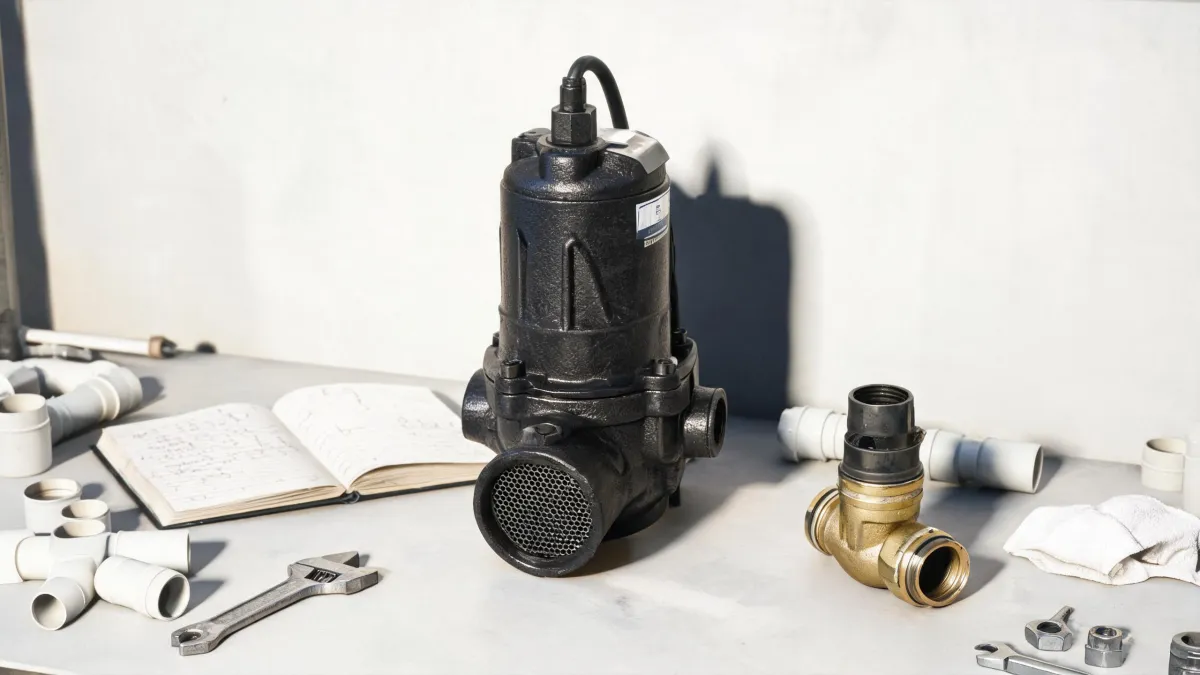
There's No Single Right Answer
Ask ten plumbers whether to repair or replace a failing sewage pump and you'll get ten confident answers. Most of them will be wrong for your specific situation.
I coordinate emergency pump service at a plumbing and pump supply company. Since 2016, I've handled more than 400 rush calls — including same-day turnarounds for property managers running buildings with 40+ units. In my experience, the right move comes down to three things: how fast water is coming in, whether the motor is actually dead, and who's writing the check.
Here's how I triage it. Find your scenario, then read only the part that applies to you.
Scenario 1: Water Is Rising Right Now
You don't rebuild. You replace. Full stop.
A Zoeller pump rebuild kit is a genuinely good product (I recommend them all the time) — for planned maintenance. It is not a product for a basement that's actively taking on water. Pulling the pump, opening the housing, checking the switch, replacing seals, and reassembling takes an hour or more of careful bench work. You do not have an hour. You have roughly twenty minutes before this stops being a repair and starts being an insurance claim.
So: full replacement, matched to the basin size and discharge line. Not the biggest pump on the shelf — the right one. If the space is finished, add a battery backup before you leave the job. Every contractor I know has a version of this story and they all end the same way: the backup pays for itself on the next storm, not this one.
The value of a battery backup isn't the outage you're preparing for. It's the one you don't know about yet.
In March 2024, a property manager called me at 10:40 PM on a Wednesday. Failed sump, water already across the floor. We had a replacement in by 11:30. She pushed back on the battery backup (another $400 on a night she was already spending money — fair reaction). Two weeks later the power went out during a storm. No second call. That's the whole pitch, and I didn't have to make it.
Scenario 2: The Pump Is Failing, But the Basin Is Holding
Now the rebuild kit makes sense — if the motor is still good.
The rule I give people: if the motor hums and the shaft spins, rebuild. If the motor is silent, the housing is cracked, or the casting is rusted through, don't. A Zoeller pump rebuild kit replaces the wear parts — the switch, the seals, sometimes the impeller. It can't replace a motor that's already burned out, and it can't fix a housing that's been sitting in sewage for a decade.
Timeline for comparison: a rebuild is roughly 1–2 hours of bench work. A straight swap is about 45 minutes if everything's already on the truck. If you've got the time, rebuild. If you don't, you've already switched back to Scenario 1.
One thing I'd flag: we didn't have a formal triage checklist for years. We just sort of "knew" which calls were which. That worked until it didn't. In 2021 it cost us a client — a junior tech rebuilt a pump that should've been replaced, the motor died six weeks later, and the same basement flooded twice. There's now a one-page checklist taped inside every service van. I probably should have written it after the first time it went wrong instead of the second.
Scenario 3: You're Pricing the Job for a Client
This is where most of the real damage gets done — not on the job, but on the quote.
I've learned to ask "what's not included" before I ask "what's the price." The vendor who lists every fee upfront usually costs less in the end than the one who quotes low and adds line items later.
We were using the same words and meaning different things. I once told a client we'd install a "standard-size" Zoeller sewage pump system. She heard "standard" as in "whatever's normal for this kind of building." I meant "the standard base model in our catalog." Those are not the same pump. We found out when the discharge line didn't match the basin outlet, and a ninety-minute job turned into a three-hour afternoon. Nobody was wrong exactly. Still cost me the day.
My position on pricing makes some salespeople uncomfortable, but it's the one I'd defend in writing: the number on the quote should be the number on the invoice. If there's a setup fee, a disposal fee, a haul-away fee, or a weekend surcharge, it goes on the quote. Every time. The contractor who hides fees to look cheaper upfront isn't cheaper. They're just delaying the argument until you're standing in a wet basement with no leverage.
Tool Habits That Decide How Long This Actually Takes
Whatever scenario you're in, job speed comes down to whether your tools are ready before you need them. Three of these come up constantly:
- Hex keys. A folding set — something like the 70550 pro folding hex key set — lives in the truck for one reason: folding sets don't roll under the pump. On a wet floor at 11 PM, you want the set that stays in one piece, not the loose L-keys you'll be fishing out of a drain by flashlight.
- Bit changes on an impact driver. People constantly ask how to fit a drill bit into an impact driver, and the honest answer is: you don't tighten it. Most impact drivers use a 1/4-inch hex quick-change collar — pull the collar back, push the bit in until it clicks, release. That's the whole procedure. No chuck to crank down on. If you're fighting a tightening chuck, you picked up a drill, not an impact driver.
- The tool box question. Searches for "most expensive tool box" are always interesting to me. A $1,200 box isn't a status symbol; it's an organization decision. If it stops you from losing the same 10mm socket every week, it pays for itself inside a year. If it just sits on the truck looking expensive, it doesn't. Buy organization, not logos.
How to Know Which Scenario You're Standing In
Walk outside for thirty seconds and ask yourself three questions. Is water actively moving? If yes, you're in Scenario 1 — replace, don't overthink it. Is the motor making any sound at all? If yes, you're in Scenario 2 and a rebuild is on the table. If the motor is silent, you're back in Scenario 1. And if this is a job you're quoting rather than doing, you're always in Scenario 3 — the pricing rules don't change based on urgency, they change based on who's paying.
The reason I lay it out this way is that most pump advice you'll find online collapses all three scenarios into one. That's how contractors end up standing in a flooded basement trying to save $200 on a rebuild they didn't have time for. The answer isn't "repair" or "replace." The answer is knowing which question you're actually being asked.

Leave a Reply