-
The cheapest quote you see is almost never the price you pay.
-
What a "cheap" sump pump install actually costs
-
The wear ring in a centrifugal pump tells the whole story
-
Your air compressor pressure switch and jigsaw parts are no different
-
"But I'm on a budget — I can't always buy the expensive option"
-
Transparent pricing is the only quote that means anything
The cheapest quote you see is almost never the price you pay.
I mean that literally. In my experience coordinating emergency orders for contractors and plumbing supply customers, the lowest sticker price leads to the highest total cost roughly seven times out of ten. Not because cheap parts are inherently bad — but because the quote hides what you'll actually spend.
I've seen this pattern across sump pumps, replacement parts, and even power tools. The parts that look like a deal on paper turn into the ones that fail at 2am during a storm or stall a job site for three days. The math doesn't work out the way you think it does.
Here's why — and how to spot it before you commit.
What a "cheap" sump pump install actually costs
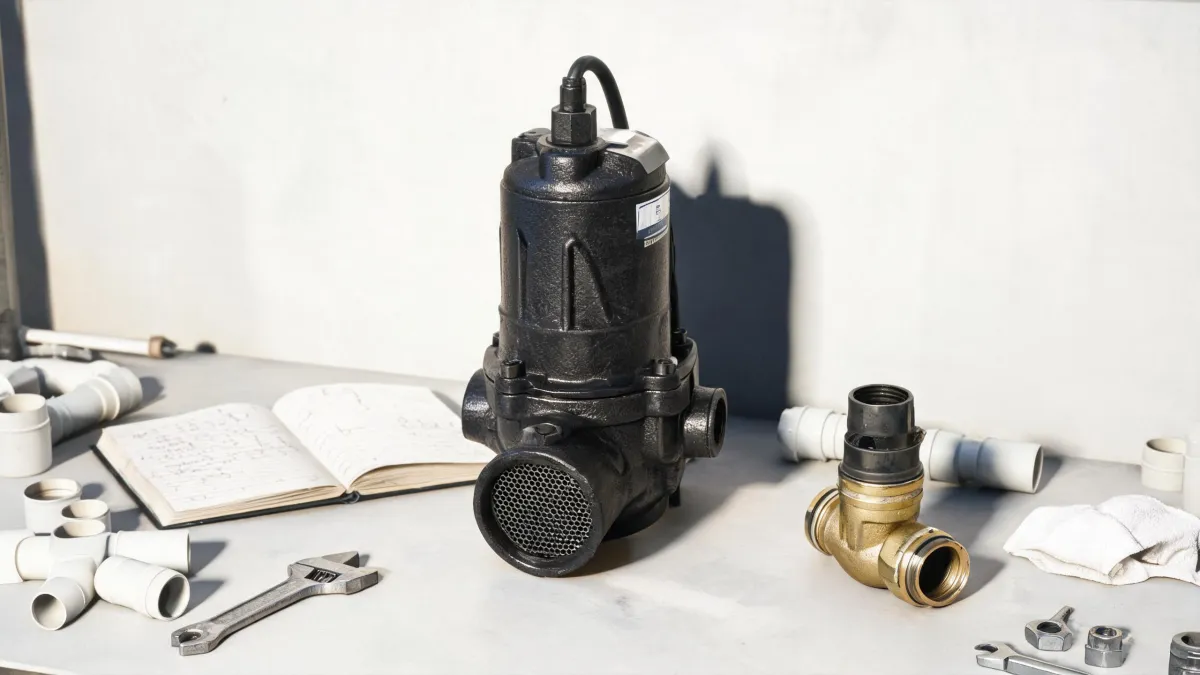
Search "how to install Zoeller sump pump" and you'll find plenty of guides listing the pump price and some basic steps. That's fine as far as it goes. But the install quote is where things get murky.
I worked with a contractor in late 2023 who thought he'd found a great deal: a $280 quote for a Zoeller sump pump install. The pump itself was $180. Labor was the rest. Seemed reasonable.
Then the extras started. A check valve wasn't included — that's another $40. The discharge pipe fittings added $60. The pit cover with the right seal? $85. Electrical connection parts? $35. He ended up at nearly $550 total, and the "cheap" install took two trips because nobody had the right parts on the truck the first time.
Not a scam. Just a quote that didn't say what it excluded.
I don't have hard data on how often this happens across the industry, but based on the orders I've processed, I'd estimate that about 30-40% of "low" install quotes are missing at least two necessary components. That's not a small gap.
"I've learned to ask 'what's NOT included' before 'what's the price.'"
The wear ring in a centrifugal pump tells the whole story
Here's a smaller-scale example that proves the same point.
What is a wear ring in a centrifugal pump? It's a replaceable ring that sits between the impeller and the pump casing. Its job is to maintain a tight clearance so fluid doesn't recirculate inside the pump. Without it, the pump loses efficiency fast — and the casing wears out.
A wear ring costs anywhere from $15 to $40 depending on the material and spec. A cheap one runs maybe $12. That $3 difference is nothing, right?
Except the cheap ring doesn't hold tolerance. It wears unevenly. Within 8-10 months, the clearance opens up, the pump starts losing pressure, and you're looking at a $250-400 repair — or a full replacement.
I saw this exact scenario three times last year with different customers. Each one thought they were saving money. Each one paid more within a year.
The same logic applies to the Zoeller Drain Pump 105. It's a solid little unit — that's why it's popular. But when it needs a replacement part, using an off-spec component doesn't save money. It just shifts the cost to a later, more inconvenient time.
Your air compressor pressure switch and jigsaw parts are no different
Tools follow the same rule.
Take air compressor pressure switch adjustment. A good switch costs $25-45 depending on the spec. A cheap one is $15. But the cheap switch often arrives uncalibrated or with a narrow adjustment range. You spend an hour trying to dial it in, and it still cuts in and out at the wrong pressure. That's an hour of your time — plus the frustration — plus the risk that your compressor runs hotter than it should.
Jigsaw parts are even more straightforward. A replacement base plate or blade clamp from the original manufacturer costs a few dollars more. A generic part might not align perfectly, which means your cuts drift, your blades break faster, and your tool wears out prematurely.
I've seen this on job sites. The guy who bought the $8 generic part spent $60 on replacement blades and an extra afternoon redoing cuts. The guy who bought the $14 OEM part finished the job and moved on.
Neither of them thinks about it afterward. That's the point. The right part just works. The cheap part becomes a story you tell later.
"But I'm on a budget — I can't always buy the expensive option"
Fair. I've been there, and I've made that call myself. Sometimes you need the $15 switch because that's what you have right now.
I get it. But here's what I've learned: the goal isn't to buy the most expensive option. It's to buy the option that doesn't cost you twice.
If budget is the constraint, adjust the timeline, not the quality. Wait a week for the right part. Source it from a different supplier. Buy the mid-tier option instead of the bottom-tier one. But don't pretend the cheapest choice is the same as the right choice. It isn't.
I'm not saying every expensive part is worth it. Some premium pricing is just marketing. But if I have to choose between a part that might last 8 months and a part that should last 4 years, I'll pay the difference every time. Not because I'm a perfectionist. Because I've done the math on what "cheap" actually costs.
Transparent pricing is the only quote that means anything
Here's the takeaway, and I'll be direct about it: the supplier who lists everything upfront — even if the total looks higher — almost always costs you less in the end.
That's not a marketing slogan. It's just what the numbers say. The quote that hides the check valve, the fittings, and the labor surcharge isn't a better deal. It's a worse deal that hasn't finished revealing itself yet.
So next time you're comparing a pump, a part, or a tool, ask one question before you decide:
"What's not included in this price?"
The answer will tell you more than the sticker ever will.

Leave a Reply