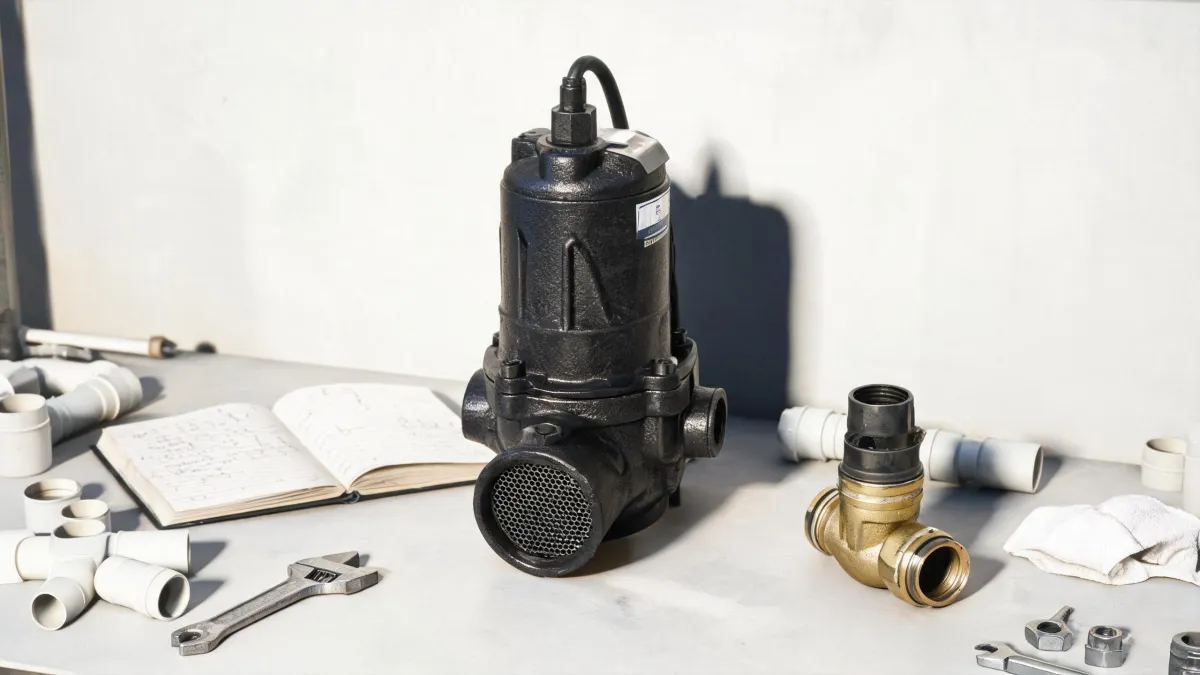
October 2025. A Tuesday. I was two emails deep into a vendor dispute when our facility manager walked in with that look — the one that means something is leaking, smoking, or backing up.
"Basement bathroom's flooded," he said. "Sewage."
Our building has a below-grade bathroom that depends on a sewage ejector pump to push waste up to the main sewer line. That pump had just quit. Not a slow decline — a hard stop. Standing water, a closed bathroom, and 45 employees asking when it would be fixed.
That's how I ended up spending the week reading Zoeller pumps reviews instead of arguing about invoices.
Why the Zoeller ejector pump M267 ended up on our list
Quick background: I'm the office administrator for a mid-sized building maintenance company. I manage about $180,000 a year in supply purchases across eight vendors. That includes everything from paper towels to pumps, which means I'm the person who gets handed problems like "find me a sewage pump by Friday."
Our plumber gave us a shortlist. Most contractors he knew, he said, spec'd a Zoeller ejector pump M267 for jobs like ours: light commercial, basement bathroom, maybe heavier use around events and holidays. He called it the boringly standard answer for smaller sewage ejector duty.
I nodded and started researching. The specs on the M267 jumped out:
- 1/3 HP motor
- Cast iron volute
- 2-inch NPT discharge
- Handles up to 2-inch solids
That last point matters more than it sounds. A sewage ejector pump has got to handle the stuff people flush when they shouldn't. A pump that can't pass solids will clog, overheat, and die early. Cast iron also dissipates heat better, so the motor is less likely to trip off under a heavy load. That detail would matter later. The specs above are straight from Zoeller's published data sheet for the M267, by the way — worth pulling up before you compare anything else.
The price conversation
Here's where I'll be honest. My first reaction was sticker shock.
The M267 came in around $415 from our distributor. Kinda painful to see on paper next to the $200 option at the big-box store. Our controller saw the quote and asked, "Can't you find something closer to $200?"
I found one. Plastic volute. Smaller discharge. A piggyback float switch that plugged straight into the cord. Its reviews were mostly from homeowners who'd installed one in a weekend.
Then our plumber asked a question that stopped the conversation: "How often do you want to do this again?"
Because the pump we were replacing — the one that had just flooded a bathroom — was exactly that kind of budget unit. Three years old. Serviced twice. The float hung up, the motor ran dry, and that was that. That's the failure sequence, in case you ever wonder how these things die.
I have mixed feelings about "contractor-grade" pricing. On one hand, it feels like upselling. On the other hand, we'd already spent close to $700 on the cheap pump over three years — repairs, after-hours plumber calls, and the cost of a closed bathroom when it failed in 2024.
The math won. The M267 wasn't the expensive option. It was the cheaper one over time.
That lesson keeps repeating across my orders. The 1/4 inch drive click torque wrench our mechanics requested last month — the budget one looks fine hanging on a pegboard, but it doesn't click at the same torque twice in a row. On a brake caliper bolt, that's not a place for gambling. Same story. Buy it once, buy it right.
Ordering the M267: what surprised me
Once we committed, the purchase process taught me three things.
1. The M267 is a pump-only unit. It doesn't ship with a float switch. You need a compatible piggyback float or a separate basin control system. I almost missed this. If I'd ordered just the pump and expected plug-and-play, the install would have stalled while everyone stared at a part we didn't have. (This is the #1 source of confusion in M267 reviews, by the way.)
2. The basin system matters just as much. The pump is one part of the ejector system. You still need the basin, the inlet hub, venting, discharge piping, and a check valve. We replaced the pump and the float, then discovered the old check valve was barely holding, so we replaced that too. If you're already pulling the old pump, change the check valve while you're in there. It's a cheap part and a miserable one to access later.
3. Be careful where you buy. The M267 is popular enough that gray-market sellers list lookalikes on online marketplaces. The castings and motors are not the same. Buy from an authorized distributor if you possibly can. With a genuine M267, you get the manufacturer's warranty and support. With a knockoff, you get a box.
The install: the day everything went right
Our plumber handled the installation in about a day. The old piping fought him a bit, but the M267 dropped into the existing basin without drama. He wired the float through the piggyback plug, filled the basin with water, and let the float rise.
The pump kicked on with a low, solid hum. It cleared the test load, shut off cleanly when the float dropped, and that was it.
I'm not a mechanical person. I'm a purchasing person. But watching a piece of equipment do exactly what it's supposed to do — quietly, on the first try, no smoke, no alarms — is genuinely anticlimactic. And that, honestly, is the point.
The surprise wasn't the price or the specs. The surprise was realizing how long we'd been living with a pump that sounded like a washing machine full of bolts, and a plumber saying "it's still running, so..." — and how "broken" had become normal.
What the Zoeller pumps reviews actually say
Reviews had a big role in our decision. Here's the pattern I noticed across contractor reviews of the M267:
"Installed it and forgot about it."
That phrase comes up over and over. Contractors don't get excited about the M267. They just keep installing it because they don't want a 2 AM callback from a customer standing in sewage. Reliability is the whole review.
There are also plenty of confused buyers asking why the pump doesn't come with a float switch. That's the pump-only configuration catching people off guard — the same mistake I almost made. Read the product description carefully.
Based on listings I checked in late 2025, genuine M267 pricing ran roughly $380–$460 depending on the distributor. Gray-market listings showed up lower. I'd be suspicious of anything way below that range.
Buying pumps vs. buying chainsaws vs. buying torque wrenches
A few weeks later, the grounds crew asked me to find a chainsaw for sale near me. I ended up at a local dealer who carried both homeowner and professional models.
Same story, different aisle. The budget saw would cut branches fine. But the crew has learned that those saws burn out in a couple of seasons. The professional saw costs more up front and lasts three times as long. We bought the professional saw.
And earlier this week, a shop hand asked me, "what is a grinding wheel dresser used for?" — genuinely curious, because everyone in the shop just assumed you throw away grinding wheels when they glaze over. A dresser cleans the wheel face and restores its cutting edge. It costs less than a new wheel. Same principle in miniature: spend a little on the right tool, save money everywhere else.
That's the boring truth I keep landing on. In this job, the cheapest option is rarely the most economical. The Zoeller M267 is another version of that same lesson, just with more sewage involved.
What I'd tell another buyer looking at the M267
If you're in my position — desk job, in charge of the purchase order, not a plumber — here's what I'd want you to know:
- Buy the genuine model. The M267 is popular, so knockoffs exist. Authorized distributor, not the cheapest marketplace listing.
- Order the float kit at the same time. It's a pump-only unit. You need a piggyback float or a basin control system.
- Replace the check valve while the system is open. One cheap part; saves you a second service call.
- Compare total cost, not unit price. Our old cheap pump cost roughly $700 over three years with repairs. A solid pump at $415 with no callbacks so far is the cheaper one.
- Verify current pricing. This was accurate as of Q4 2025. Pumps and shipping prices move with the market, so check with a local distributor before you budget.
It's been a few months now. The basement bathroom is open. The crew hasn't had to use the porta-potty out back. Nobody has had to apologize to anybody about sewage in the hallway.
Hearing nothing back from that pump is the best review I can give it.

Leave a Reply