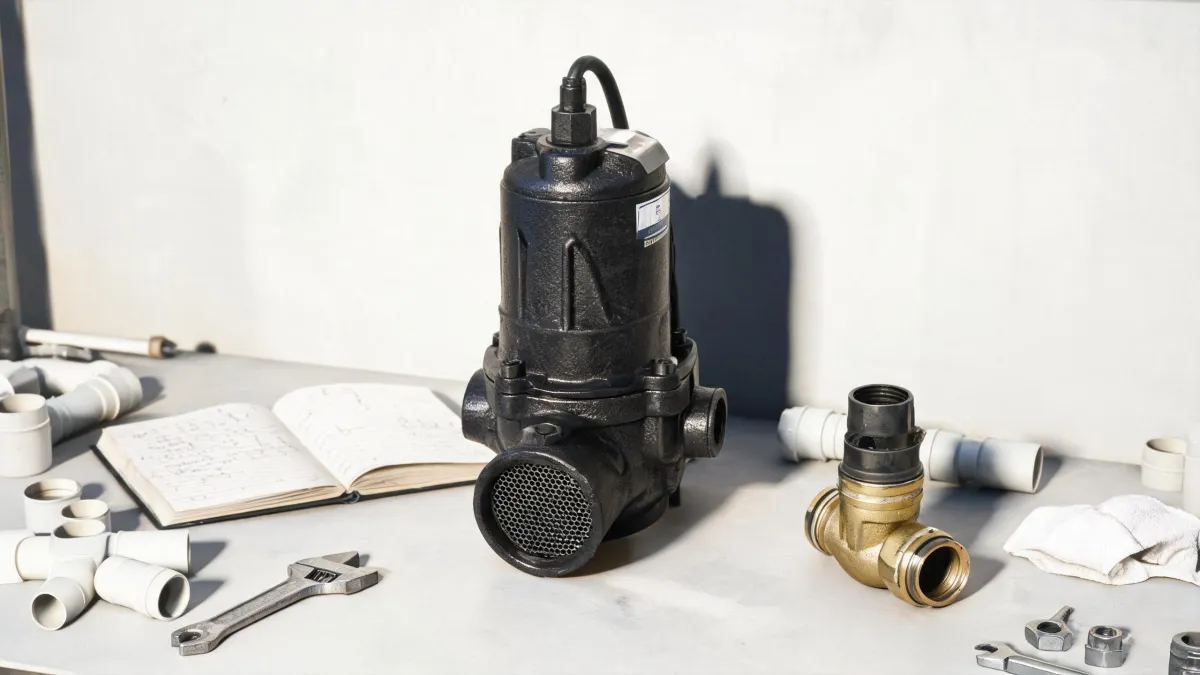
Someone asked me recently: Should I get the Zoeller 50 Series submersible sump pump or the Zoeller Pump Company AquaNot 508 pump? Which one is better?
It's a fair question, but honestly it's the wrong question. These two pumps aren't replacements for each other. One is a primary pump. The other is a backup system. That means this isn't a winner-takes-all comparison. It's a what job are you hiring each one to do comparison.
I've been installing and repairing sump pumps for about eight years now. In 2017, my first year, I told a homeowner they didn't need a backup pump. I was wrong. A month later, a storm knocked out their power and the basement flooded. I still remember that call. That's why I now compare equipment in whole systems, not single boxes.
Here's the framework I use: role, power draw, total cost, and failure risk. Each of those gives you a clear answer, and then we'll talk about what I'd actually choose.
1. Role: 50 Series vs AquaNot 508
The Zoeller 50 Series submersible sump pump is the workhorse. It sits in the sump pit, runs on standard household power, and moves groundwater out day after day. It's cast iron, built for continuous duty, and the kind of pump a contractor installs when they don't want to come back.
The Zoeller Pump Company AquaNot 508 pump is not a replacement for that. It's a backup system. It runs off a battery and is designed to take over when the primary pump can't: power outage, high water, or a failed primary motor in the middle of the night.
What most people don't realize is that a backup pump doesn't need to match the primary pump's capacity. It needs to buy you time. It needs to keep water from reaching your finished floor until someone can solve the bigger problem. That changes how you read the spec sheet.
Conclusion: If you only buy one, buy the 50 Series. If you're planning to use the AquaNot 508 as a primary pump, you're planning the wrong system.
2. Power Draw: How Many Amps Does a 1 HP Submersible Pump Draw?
This question comes up more than you'd expect, and I get why. Nobody wants to burn out a circuit during a storm.
According to the U.S. Department of Energy (energy.gov), 1 HP equals 746 watts. At 120 volts, that's 6.2 amps before you account for motor efficiency and startup. A real 1 HP submersible pump usually pulls more like 8 to 11 amps while it's running.
But running amps are only part of the story. The startup surge can be two to three times that for a couple seconds. That's what trips breakers.
I learned this one the hard way. In September 2022, I was using a corded circular saw on the same circuit as a sump pump. The pump kicked on mid-cut and the breaker tripped. It wasn't a dramatic failure. It was just annoying, and it could have been a real problem if it had happened during a storm. Trust me on this one: don't run a sump pump and a corded circular saw on the same circuit.
The AquaNot 508 is different here because it doesn't add to your household load. It draws from the battery, not the utility. So when you're calculating how many amps you need, the backup pump doesn't create the same spike.
Conclusion: Don't size a circuit around the pump's running amps. Size it around the startup surge, and keep big tools on their own circuit.
3. Total Cost: 50 Series vs AquaNot 508
If you just compare asking prices, the 50 Series looks reasonable and the AquaNot 508 looks expensive. But I've learned to ask what's not included before I ask what the price is. That's true for any vendor or any system.
A backup system has a battery, and batteries are consumable. You'll likely replace it every three to five years depending on use, temperature, and how often the system actually runs. That's not a hidden fee, but it's easy to forget if you're staring at a sticker price.
The flood that backup prevents is also part of the math. A finished basement with a few inches of water can create thousands of dollars in damage. I'm not saying that to scare you. I'm just saying the real total cost includes the failure you're trying to avoid.
Don't hold me to exact numbers, because they vary by region and distributor. In early 2025, I was seeing the 50 Series roughly in the $150 to $250 range and the AquaNot 508 in the $400 to $600 range, plus a battery. Verify current pricing before you order.
Granted, you might get away with a primary pump only. Plenty of people do. But that's luck, not planning.
Conclusion: The lowest upfront option often isn't the lowest total cost. Ask what breaks, what needs replacing, and what a flooded basement costs in your case.
4. Failure Risk: 50 Series vs AquaNot 508
Every pump can fail. The 50 Series can develop a bad float switch. The AquaNot 508 can have a dead battery or a controller that doesn't switch over. No pump is failure-proof, and I won't promise you one.
Here's something vendors won't tell you: battery backup systems usually fail because of the battery, not the pump. If you install it and never test it, you'll discover the problem at the exact worst moment.
I did this myself. In Q1 2024, I replaced a primary pump that didn't need replacing. The pump was fine. A bad check valve was making the float cycle and the motor run hotter than normal. That mistake cost about $430 in parts and labor, plus the embarrassment of recommending a part swap that was unnecessary. Now I maintain a checklist for our team so nobody repeats it.
More pumps does mean more parts. I get that argument. But a system with both pumps covers more failure modes: a power outage, a primary pump failure, a stuck float, an overloaded circuit. The goal is not zero failure points. The goal is no flood.
Conclusion: A backup pump isn't a second primary pump. It's insurance, and like any insurance, it only works if you maintain it.
Sump Pump Repair: The Checklist That Saves the Call
Most sump pump repair calls I've made were actually design or installation problems, not pump failures. Before you order a new pump, check the basics:
- Is the float free? Tether floats get tangled all the time.
- Is the check valve installed and working? A bad check valve makes the pump short-cycle and burns it out.
- Is the discharge line clear? A blocked line can make a perfectly good pump run and run.
- Is the breaker tripping? Measure the running amps. A motor that draws more than its nameplate is telling you something.
- Is the pump properly sized for your pit and head height? Bigger isn't always better.
That last one is counterintuitive for a lot of people. A 1 HP pump isn't automatically better than a 1/2 HP pump. If your pit is small and your water table is slow, a larger pump can cycle faster, and fast cycling can wear out a float switch. The best pump is the one sized for the job, not the biggest number on the box.
Which Should You Choose?
Some houses honestly don't need both. I do not think every basement needs backup protection. But you need to make that call based on your risk, not the guy on the internet's opinion.
If I had a bare concrete crawl space, no finished storage, and no history of flooding, I'd probably install the 50 Series and skip the backup. I'd still test it every spring, and I'd put the test date on my calendar.
If I had a finished basement, I'd install both. That's not me being dramatic. That's me being honest about what a flooded basement does to drywall, flooring, and everything else stored at floor level.
If my primary pump was already more than ten years old, I'd replace it with the 50 Series and add the AquaNot 508 at the same time. It's easier to install both while the pit is open than to go back after the floor is finished.
I can only speak to the jobs I've documented and the region I work in. If you're dealing with a high water table, a different climate, or a weird sump shape, the calculus might be different. That's okay. Get someone to measure the pit and actually think through your scenario.
My honest answer: The 50 Series is the right primary pump. The AquaNot 508 is the right backup. You don't have to choose between a workhorse and an insurance policy. You just have to decide how much flood risk you're willing to accept.

Leave a Reply