The old shortcut doesn't hold up anymore
If you still pick pumps and tools by matching one spec — horsepower, length, or whatever number is printed largest on the box — you're probably buying wrong, and you won't find out for months.
I'm not being dramatic. I've been the person signing off on the purchase orders for a mid-size operation for the past five years. Office administrator, roughly 40 employees, three service locations, and somewhere around $180K a year cycling through vendors. Pumps, hand tools, maintenance supplies, the whole thing. I don't install them. I order them, I get the invoices approved, and I hear about it when the field guys are unhappy.
And what I keep seeing is that the way contractors were taught to spec equipment five or six years ago doesn't map cleanly onto what's actually being sold now. That's not the vendors' fault. It's just that the category got more specific — and nobody updated the shortcuts.
Horsepower is a starting point, not an answer
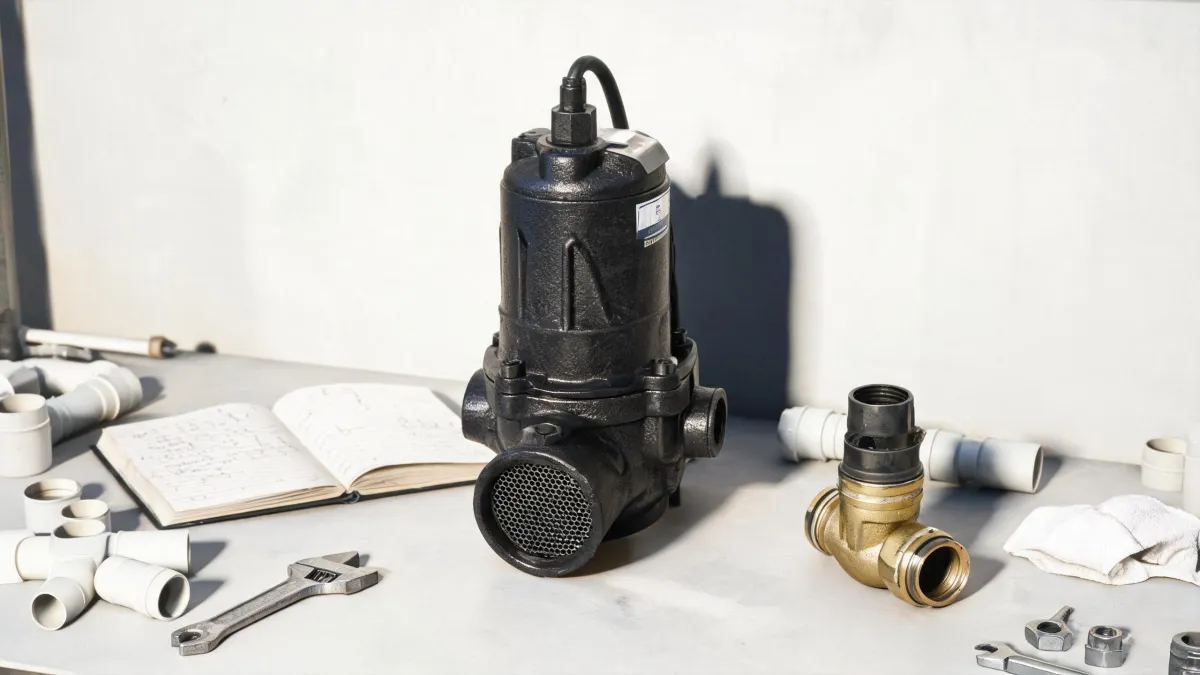
Take the Zoeller M267 1/2 HP 115V sewage pump. Great unit. But three years ago, if I got a requisition for "a 1/2 HP sewage pump," I'd have four or five SKUs to choose from and I could pick almost any of them and be fine.
Now? That same request could mean the M267. It could mean an N98 submersible sump pump. It could mean a Zoeller 820 grinder pump. Three completely different machines, all in the same rough horsepower neighborhood, and picking the wrong one is the kind of mistake that shows up 14 months later as a service call.
I had a situation two years back — and I'm still a little embarrassed about it — where I assumed the head pressure on two roughly equivalent units would match because the HP matched. Didn't verify. Turned out one was rated for a shallower lift depth, and it sat in a pit where it was working right at the edge of its curve. It never failed catastrophically. It just wore out early, and the replacement cost came out of my budget, not the manufacturer's.
Lesson learned. Assumptions about "equivalent" specs cost more than the difference between the right part and the almost-right part.
Tools went through the same expansion
People assume this is a pumps-only conversation. It's not. A 10 inch pliers wrench is a good example. A decade ago, that phrasing meant one thing, one tool, roughly one use case. Now, the same nominal category covers everything from a basic adjustable jaw to models with parallel clamping jaws, ratcheting mechanisms, and materials built for different torque limits.
I had a requisition come through last quarter for "a pliers wrench" from a new tech, and I had to send it back with three questions: what's the pipe diameter, is it for tightening or for holding, and is the space behind the fitting accessible or tight. Answer those three, and the tool picks itself. Skip those questions, and you're buying something that'll live in the bottom of a van for two years.
Same logic applies to something as simple as choosing what grinding wheel for mower blades. The default answer — aluminum oxide, medium grit — used to be fine for basically everything. It still works. But it's not optimal for a commercial mower blade that's been heat-treated, or for a homeowner's push mower blade that's just soft stamped steel. The wheel that lasts 40 blades on one is going to glaze up on the other in about six passes.
The counterargument, and why it doesn't quite hold
I know what some of you are thinking. "It's a pump. It's a wrench. It's been working fine for 30 years. Stop overcomplicating it."
Fair. And honestly, the fundamentals haven't changed. A cast-iron housing is still better than plastic for a lot of sewage applications. A quality check valve still matters more than the pump brand. Contractors still get more value out of a unit they can service in-place than one they have to pull and ship back.
But here's the thing — "working fine" is doing a lot of subtle work in that sentence. When I started paying attention to service tickets instead of just purchase prices, I found that a significant chunk of our pump-related callbacks were linked to spec mismatches, not to product defects. A grinder pump doing a sump pump's job. A backup system sized for the wrong inflow rate. Nothing dramatic. Just the slow tax of imprecise buying.
Honestly, I'm not sure why the spec sheets have gotten so much harder to compare across models. My best guess is that manufacturers are optimizing for narrower application windows, which is technically good, but it means the buyer has to actually know their application instead of vaguely gesturing at it.
What I've actually changed
Three things, and nothing revolutionary:
- I ask two extra questions on every pump requisition now — pit depth and what's actually going into the pump. That's it. Those two answers alone have cut our wrong-size returns significantly.
- I stopped treating tool requests as interchangeable across job sites. A pliers wrench for a residential job and one for an industrial application are not the same purchase, even if the purchase order says they are.
- I keep a running list of consumables where "the default" has an asterisk next to it — grinding wheels, cutting discs, valve cartridges. Anything where the material matters more than the spec sheet suggests.
The most frustrating part of all this isn't the complexity itself. It's that the information is available — it's just not where people look for it. You find out you bought wrong when a warranty claim gets denied for "misapplication," which is a polite way of saying the buyer picked the wrong tool for the job.
So my position, and I'll keep it: veteran contractors who learned their specs in 2018 need to relearn them for 2026. Not the fundamentals. The granularity. The old rule of thumb wasn't wrong. It was just written for a catalog that no longer exists.
And the people paying for that gap aren't the ones installing the equipment. They're the ones approving the POs.

Leave a Reply