-
The Zoeller Pump Catalog Made Me Feel Like a Beginner
-
That Zoeller Sump Pump Weep Hole Is Not a Defect
-
How Do You Prime a Trash Water Pump? (Trick Question)
-
A Home Depot Run and a Lesson Already Learned
-
Small Order, Standard Respect
-
What This Job Cost (and What It Saved)
-
What the Weep Hole Taught Me About Buying
The call came in at 4:47 on a Friday. One of our long-time customers—the kind who pays on time and doesn't nickel-and-dime us—had a basement filling with water. The sump pump had quit sometime that morning, and by the time anyone noticed, there was about three inches of water across the whole basement floor. They'd already called two other outfits. Both said "Monday at the earliest."
We're a small company. Four employees, including me, and I handle procurement, which means I also end up on the occasional service call when things get tight. I grabbed my tools, ordered a replacement pump through our distributor, and headed over.
That's when the education started.
The Zoeller Pump Catalog Made Me Feel Like a Beginner
I'll be honest: before this job, I'd ordered pumps the same way I order printer paper—look up what we bought last time, match the part number, move on. But when I pulled up the Zoeller pump catalog to spec a replacement, I realized I'd been doing this wrong.
The catalog has these selection charts that force you to answer questions you didn't know you needed to ask. Total dynamic head. Vertical lift. Horizontal run. Check valve placement. If you've never spent twenty minutes with a measuring tape in a damp basement, calculating how many feet of pipe goes up before it goes sideways... let's just say it changes how you think about pumps.
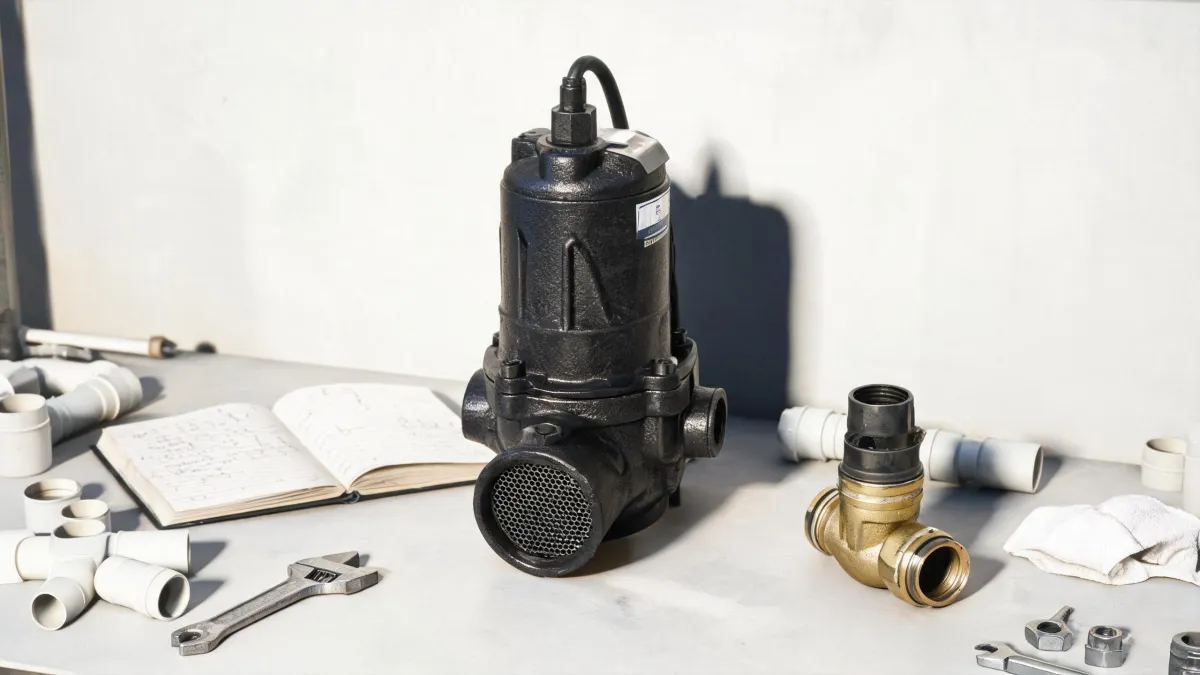
We settled on a Zoeller M53 submersible sump pump. Cast iron construction, 1/3 HP, automatic float switch. The distributor quoted us $249. Maybe $249.99, I'd have to pull the invoice. The big-box store down the road had a plastic-bodied pump for $139. I almost went with the cheaper one—I'm procurement, that's my whole thing—but something made me check the specs first.
Here's where the TCO (total cost of ownership) thing kicks in. The $139 pump had a 1-year warranty and a plastic volute. The Zoeller had a 2-year warranty and cast iron construction. When I called our distributor to ask about service history, he told me something that stopped me mid-email: "We've replaced about ten of those cheap ones for every one Zoeller we've pulled. And the ones we pull are usually 15+ years old."
$110 difference at purchase. $300+ difference in expected lifespan, not counting the labor cost of crawling into a pit and swapping a pump in the middle of a rainstorm.
That Zoeller Sump Pump Weep Hole Is Not a Defect
The pump arrived the next morning, and my guy on site—Mike, a solid plumber with 20 years in the trade—opened the box and stopped.
"You know about the weep hole on these, right?"
I did not know about the weep hole.
Mike explained that Zoeller submersible pumps have a small hole on the discharge pipe, just above the pump housing, that lets the impeller prime by allowing air to escape when the pump starts. If you plug it or install the discharge incorrectly, the pump can air-lock and run without pumping anything—burning itself out in the process.
The tricky part is orientation. The weep hole needs to be facing the right direction, positioned so it doesn't get clogged by debris, and clear of the float switch assembly. On the M53, it's a 1/8-inch hole on the adapter. Easy to miss if you aren't looking for it.
This is the kind of thing that shows up in the Zoeller catalog's installation instructions, but nobody reads those. Even Mike said he'd only learned about weep holes a few years ago, when a new pump cycled but moved zero water for two days before someone figured it out. That job cost the homeowner a service call fee, a replacement pump (under warranty, but still), and a plumber's time.
Installation lesson #1: that weep hole is a priming feature. Leave it alone, point it where the instructions say, and the pump will prime itself every time.
How Do You Prime a Trash Water Pump? (Trick Question)
With the sump pump install handled, we still had to deal with the water already in the basement. Three inches doesn't sound like a lot until you're standing in it, looking at everything you're gonna have to dry out.
We keep a small trash pump in our fleet—a 2-inch submersible unit for exactly this kind of thing. I found it in the back of the van, grabbed a hose, and set it up.
And then nothing happened.
No priming. No pumping. Just the motor running, doing its best impression of a fan.
"How do you prime a trash water pump?" I asked Mike, feeling very much like the buyer who's suddenly been asked to do the tech's job.
He looked at me like I'd asked how to tie my shoes. "You don't—submersible pumps are self-priming. Wait. Is the strainer all the way submerged?"
It was not. The water level had dropped below the strainer by the time I got the pump positioned. The pump wasn't pumping because it was churning air.
Here's the thing I learned: there are two kinds of "trash water pumps" in the field. There are submersible units like ours, which need the intake fully under water to prime. And there are centrifugal pumps that sit above the water line and need the suction hose (and the pump casing) filled with water manually before they'll self-prime. Both get called "trash pumps" in daily conversation, but they're completely different animals when you're standing in a wet basement with a deadline.
We repositioned the pump so the strainer sat in deeper water, added a brick under one side to keep the intake clear of silt, and watched it start moving water within twenty seconds. Crisis averted.
A Home Depot Run and a Lesson Already Learned
We needed a couple more things from the store. A deep standard socket set, 60 pc, because Mike's old set had a stripped 9/16 and the pump bracket bolts were standard, not metric. And a pressure washer home depot stocked, because the basement needed serious cleaning once the water was out.
Found the socket set at Home Depot—deep standard, 60 pieces, all SAE sizes, which is getting harder to find in a world that's gone mostly metric. $89. That felt high, so I almost grabbed a smaller set for $45.
Let me pause and confess something: I've survived way too many years in procurement without learning this lesson, and it cost me at least once. In my first year of doing this, I made the classic specification error—buying the cheap socket set to save $44. I stripped the 13/16 socket on the first use. The chrome split right down the side because the steel was too soft. Rounded off a bolt head in the process. That little "savings" cost me two hours of extraction work and a new bolt. The replacement socket cost $9 by itself.
So this time, I bought the $89 set, same logic as the pump purchase: pay for quality once, or pay for cheap twice.
The pressure washer was its own rabbit hole. I checked pricing while standing in the aisle at Home Depot. Their electric models run from about $119 to $300, and the gas ones go $300 to $600. We went with a $279 electric unit at 1,900 PSI. Quiet enough for indoor use, enough pressure for the floor, no gas engine to maintain. Another "not the cheapest but the right TCO" decision.
Small Order, Standard Respect
Now let's talk about how our distributor handled this. We ordered exactly one pump. One. That's nothing for a plumbing distributor that's used to moving pallets for residential builders. But the counter guy didn't sigh. Didn't tell us to call back when we had a real order. Didn't tack on a "small order fee." He spent fifteen minutes on the phone with me walking through the selection chart, confirmed stock, and had a guy load it into my truck.
That's why I do business with them. When we were a two-person outfit buying one pump at a time, they treated us the same way. The vendors who took our $200 orders seriously are the ones who still have our business now that our quarterly orders hit $8,000-$12,000.
Small doesn't mean unimportant—it means potential. The vendors who treated my small orders with respect are the ones I still use for the big ones.
What This Job Cost (and What It Saved)
Let me break down the actual numbers, since I'm the guy who tracks this stuff:
- Zoeller M53 sump pump: $249 (distributor price, February 2026)
- Dual float switch upgrade: $38
- 1-1/2" PVC check valve: $22
- Deep standard socket set, 60 pc: $89
- Pressure washer (electric, 1,900 PSI, Home Depot): $279
- Trash pump impeller replacement: $62
Total materials: $739. The "budget" alternative would have been about $334. Looks like we "overpaid" by $405. But every one of those budget choices was a future bill pretending to be a saving:
- The cheap sump pump has a 1-year warranty and a plastic housing that can crack in freezing temps. The Zoeller has a cast iron volute and a normal service life of 10-15 years. Run the math on a $139 pump that gets replaced twice as often, add labor, and the "cheap" option loses.
- The used pressure washer from classifieds has no warranty and unknown history. We rent ours to customers for $85/day when we're not using it—three rentals and the $279 unit pays for itself.
- The cheap socket set already failed me once. That's the definition of paying twice.
Prices as of February 2026; verify current rates with your distributor.
What the Weep Hole Taught Me About Buying
The part that really reframed things for me was the Zoeller sump pump weep hole. That tiny hole—smaller than a pencil tip—is the difference between a pump that moves water and a pump that burns itself out running dry. And it's not in the big marketing spread. It's in the installation instructions and in the technical section of the Zoeller pump catalog. You have to go looking for it.
The old advice about sump pumps was "buy whichever pump fits the pit." That was true forty years ago, when pits were the same size and most pumps were built from the same castings. Today, warranty terms, housing materials, and proper head-loss calculations can be the difference between a $300 fix and a $2,000 floor replacement when a pump fails at 3 AM.
I'm not saying everyone needs to become a pump engineer. But if you're buying this stuff professionally—even if your "fleet" is one pump in one basement—the twenty minutes it takes to read the technical details is worth more than the $110 you might save by not reading them.
In the end, that Friday call turned into a dry basement, a happy customer who referred us to two other property owners, and a Zoeller M53 that's still running without a hiccup. The $405 "extra" I spent that weekend has come back about three times over by now. That's not luck. That's what total cost of ownership looks like when you do the math instead of guessing.

Leave a Reply